I sat at work, counting down the hours of my last day before the Easter holiday. Halfway through the afternoon, the messages from Oliver started coming in. He had already begun his journey. First a flight from Cologne to Munich, then on to Oslo. That was where we would meet before heading to Beijing together.
During his layover in Munich, his path crossed with our friend Andreas. Andreas was on his way to Portland for a Springsteen concert. We were actually scheduled to join that same tour in mid-May for a show in Brooklyn, but more on that another time. They snapped a picture together at the airport and sent it to me. I was still at my desk.
I left 45 minutes early that day to catch the Bus4You coach from Gothenburg to Oslo. The ride took three and a half hours. The journey itself was uneventful. I arrived on time in Oslo (it was snowing), dashed across the bridge from the bus station to the train station, and caught the Flytoget airport train. Oliver was waiting for me at the terminal.
After a night of poor sleep (I was too excited about the trip), we got up at 6:30 (half an hour earlier than planned because I couldn’t sleep anyway) and headed to the airport lounge for breakfast. Our flight from Oslo to Frankfurt left at 09:54. We then had a 2-hour 15-minute layover before boarding our Air China flight from Frankfurt to Beijing at 14:11 CET. The flight took about 8.5 to 9 hours. We landed around 05:30 Beijing time. I think I managed maybe 30 minutes to an hour of sleep in total.
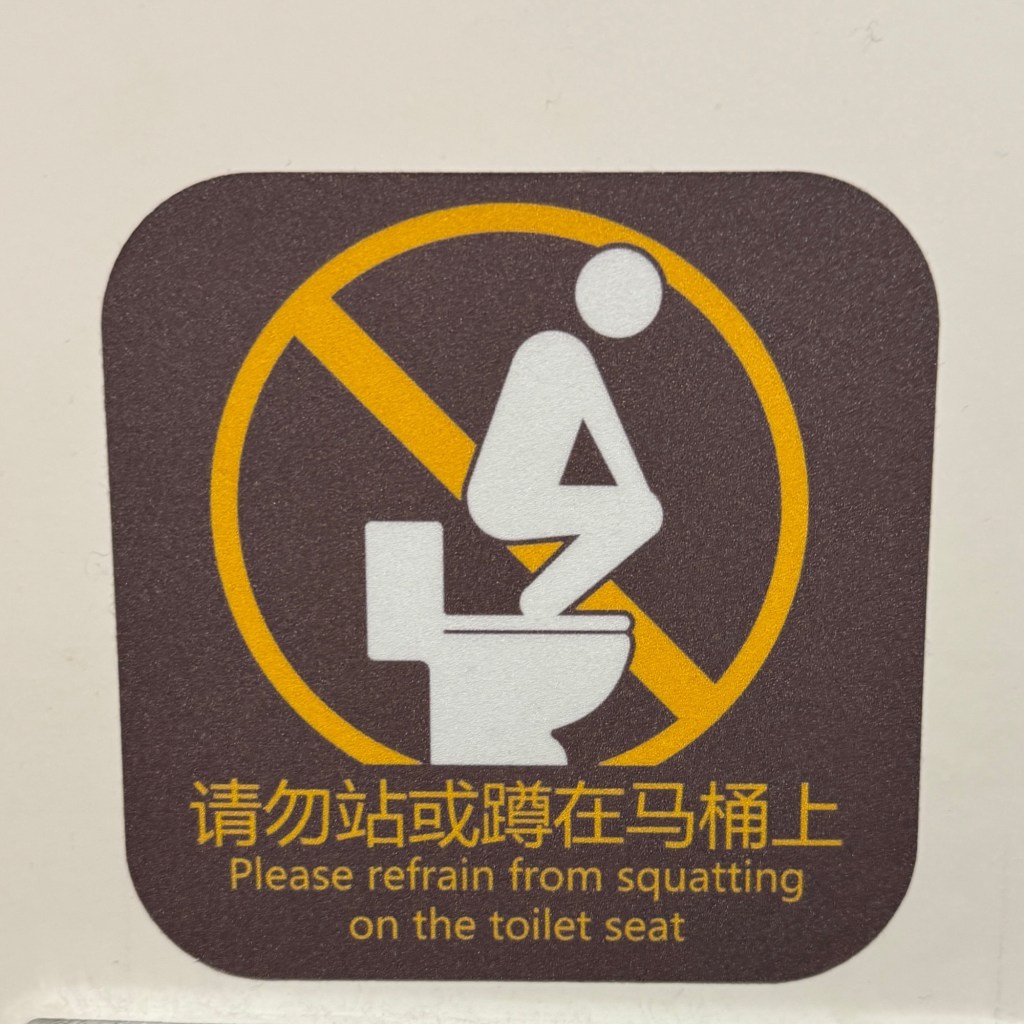
The first thing we did after landing was activate our SIM cards and Surfshark (more on how to access Google Maps in China later). I went to the restroom, where a sign made me laugh. It politely asked people not to squat on the toilet seats. It was a standard Western toilet. Of course, I would encounter actual squat toilets later on the trip.
We decided to take a DiDi (the Chinese version of Uber) to our hotel. Oliver had checked the app, which estimated the ride at around 80 RMB. On the way out, several men approached us, claiming to be DiDi drivers and offering to take us for 230 RMB. We politely declined.
Instead, we stopped at Starbucks to test Alipay. It didn’t work at first. We realized we needed to activate the account, but once that was sorted, it worked perfectly. Outside the huge terminal, we finally caught the actual DiDi that Oliver had booked. About 30 minutes later, we arrived at our hotel.
It was only around 07:30 and far too early to check in (official check-in was at 15:00). Oliver somehow managed to convince the receptionist to let us have breakfast at least. After that, we headed out into the city. We had a tour booked for 12:00: Tiananmen Square and the Forbidden City. We decided to walk. There was plenty of time.
Along the way, we learned that it was the first day of a festival (Qingming, I think), and thousands of people were heading to the square. Normally, there are three security checkpoints to get in. That day, there were more checkpoints and far more people. We started to worry that it might affect our tour. It did.
We met our guide, Tony, and a small group of tourists outside the Grand Hotel. We were each given an earpiece, and then we set off towards Tiananmen Square. After two long security lines, Tony decided to change strategy. We took the subway one stop to try entering from another direction. The lines there were just as long. It took about an hour in total to get through.
Tiananmen Square, the largest public square in the world, capable of holding up to a million people, was massive and impressive, and completely filled with tour groups and festival visitors. The weather was sunny, around 15 degrees, but very windy, and on the open square the wind felt even stronger.
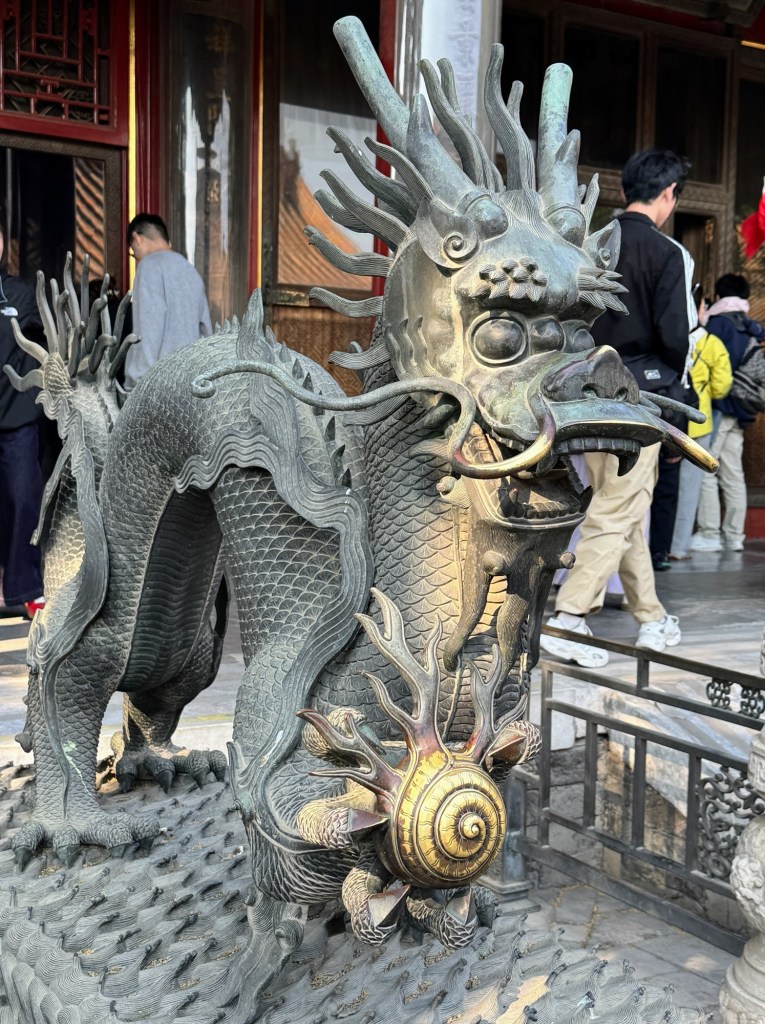
We then headed into the Forbidden City. There was another passport check at the entrance, and I was stopped for a moment. The system couldn’t find my details, even though Tony had submitted them earlier. Eventually, it worked and I was allowed through. The complex stretches about a kilometer from entrance to exit, but we didn’t walk straight through. Tony guided us through the courtyards, telling stories about the emperor, his wife, and his many concubines. By then, Oliver and I were really starting to feel the jet lag. The lack of sleep was catching up, and I felt almost dizzy and a bit nauseous.
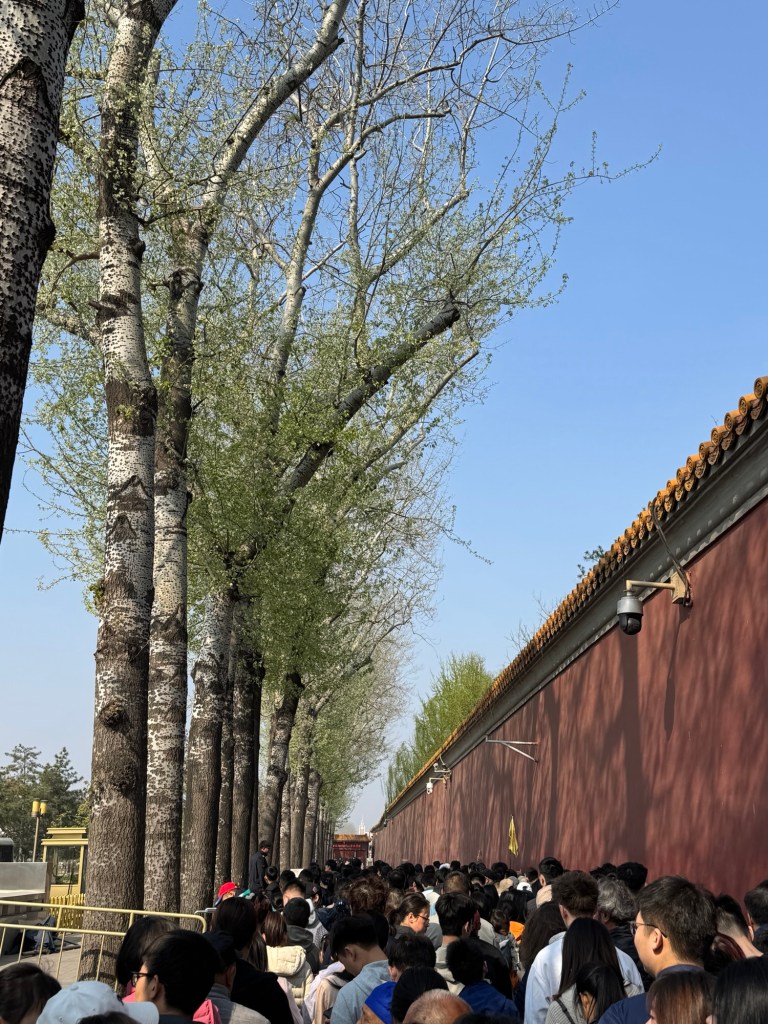

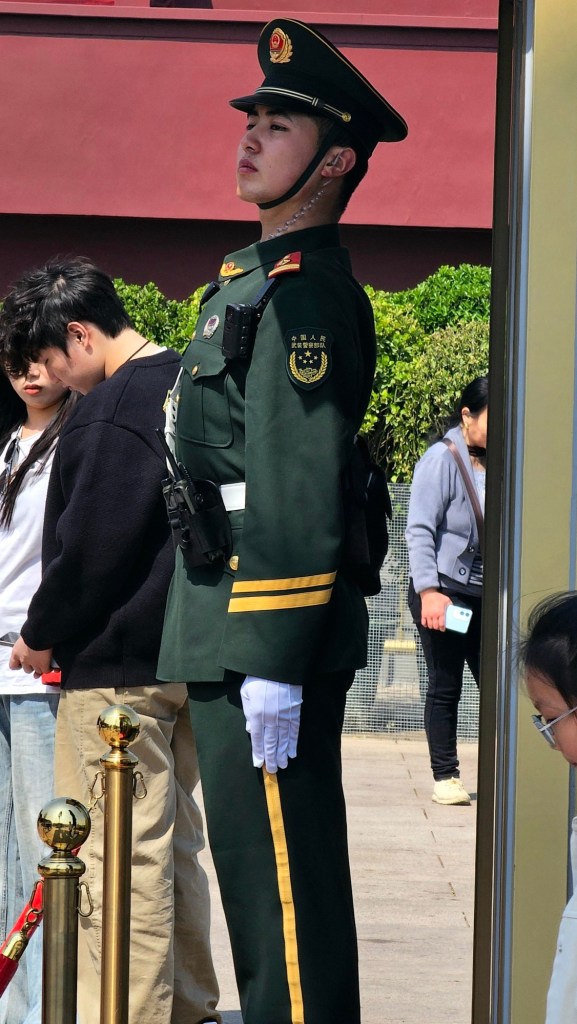
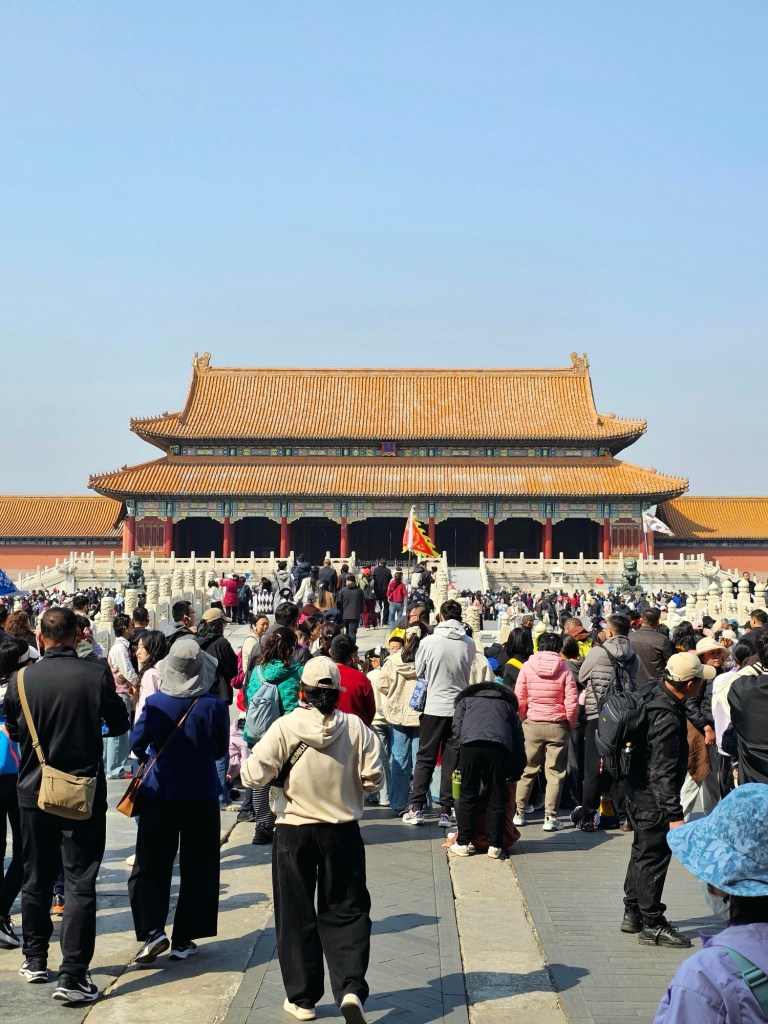
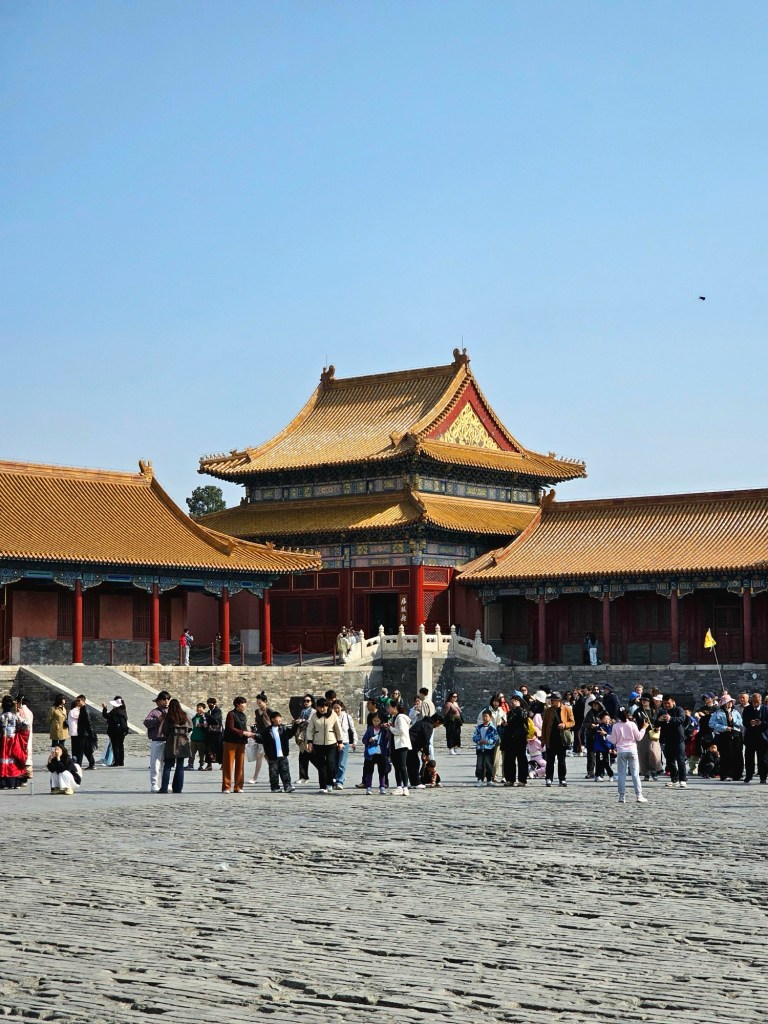
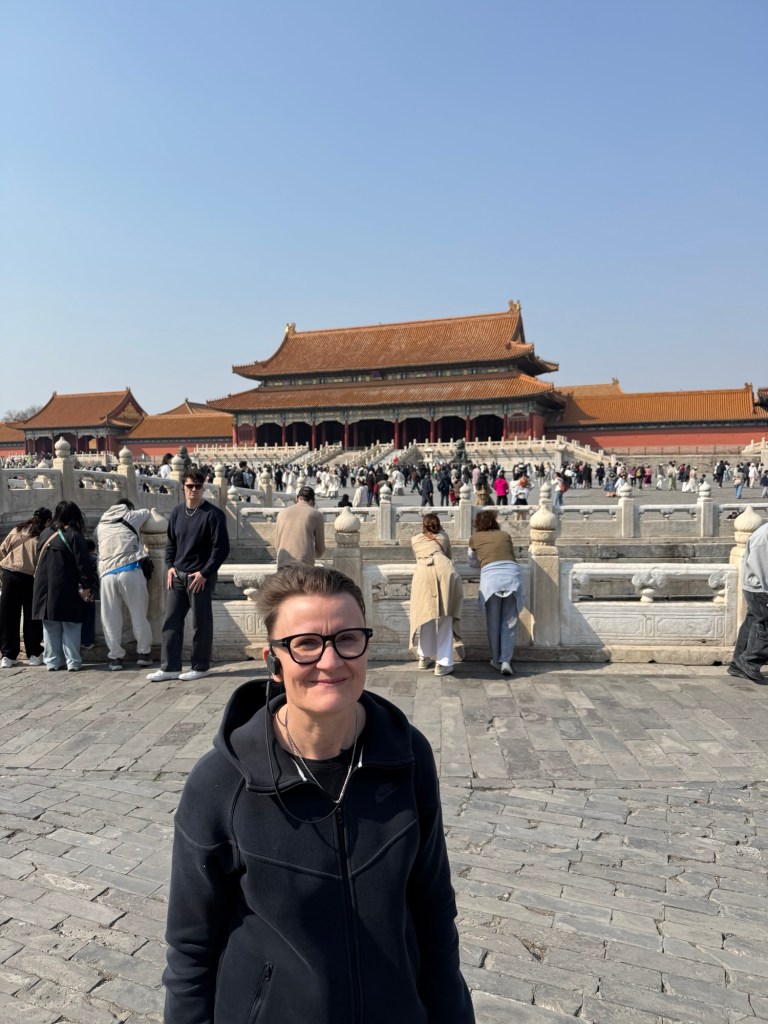
When the tour finally ended, we exited along with thousands of other visitors. We briefly considered taking a DiDi back to the hotel, but ended up walking instead. On the way, hunger suddenly hit. We stopped at a small, simple restaurant. We pointed at pictures, translated the menu with DeepL, ate, paid with Alipay, and continued back.
At the hotel, we finally checked in, showered, and collapsed into bed at around 19:00.
The next morning we had another tour booked. We were picked up at the hotel at 7:30. Right on time, a woman who introduced herself as Ashley met us and led us to a waiting car.
We were going to the Summer Palace and then the Old Summer Palace. It was a private tour, which meant no earpieces and more flexibility. Ashley told us to expect large crowds again because of the festival. That was why we were starting early.
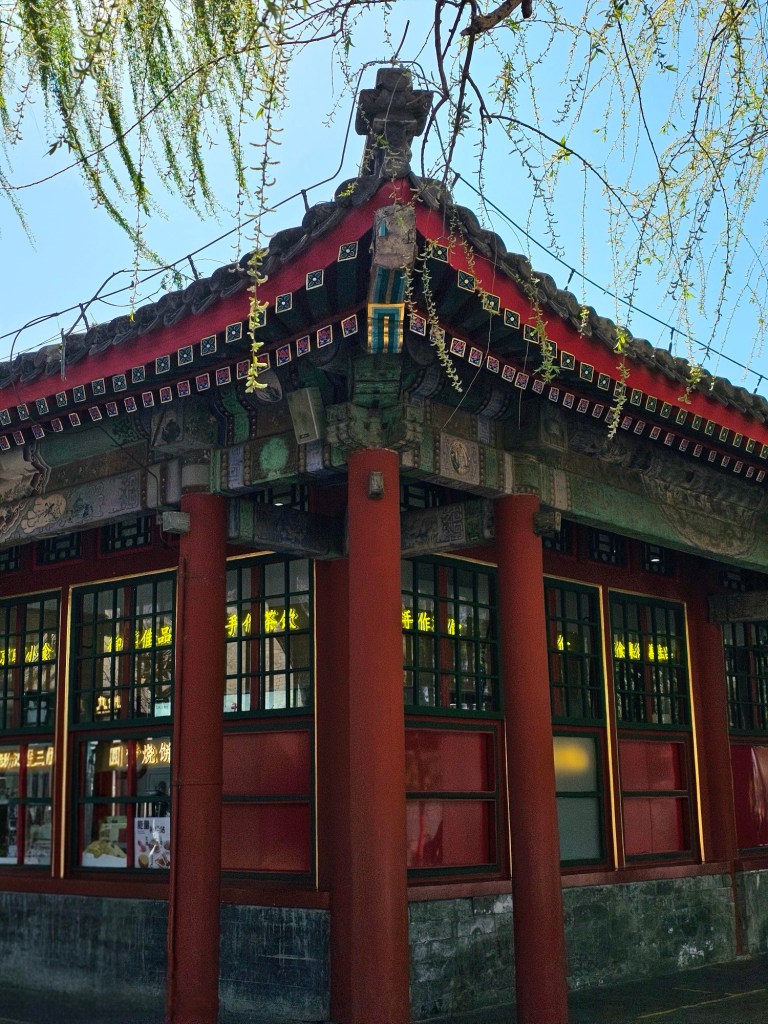
The Summer Palace was a large imperial garden just outside Beijing, originally built as a retreat for the imperial family. Rather than a single palace, it was a vast area of lakes, hills, temples, bridges, and pavilions, all carefully arranged as part of a larger landscape.
At the center were Kunming Lake and Longevity Hill, where natural scenery was shaped and combined with architecture according to traditional Chinese design principles. The site had been damaged during conflicts and later rebuilt. Today, it is recognized as a UNESCO World Heritage Site.
When we entered the gates, we had to show our passports again. Because we arrived early, the queues were manageable.
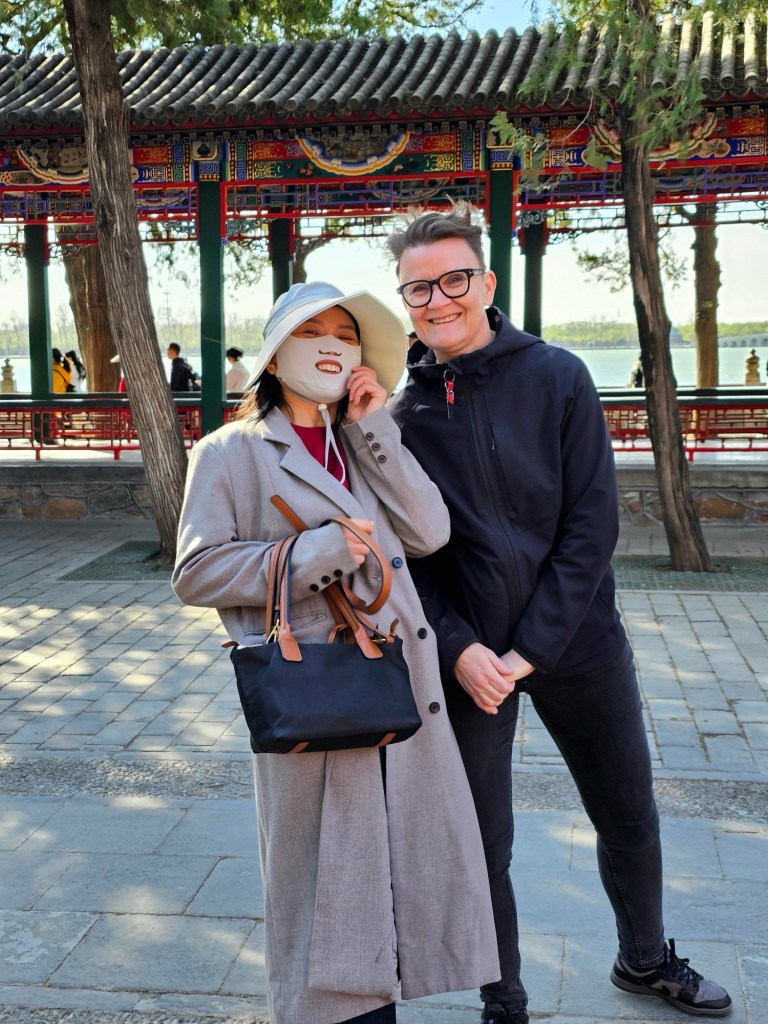
Ashley wore a fabric sun mask that covered most of her face, with small cutouts for her eyes, nose, and mouth. When I asked her about it, she explained that she gave so many outdoor tours and wanted to protect her skin from the sun. I also noticed that pale skin seemed to be considered beautiful, and we had already seen many young girls wearing white face make-up.
What struck me about the Summer Palace was its size. It was hard to imagine that it had been built only to please the emperor and his family.
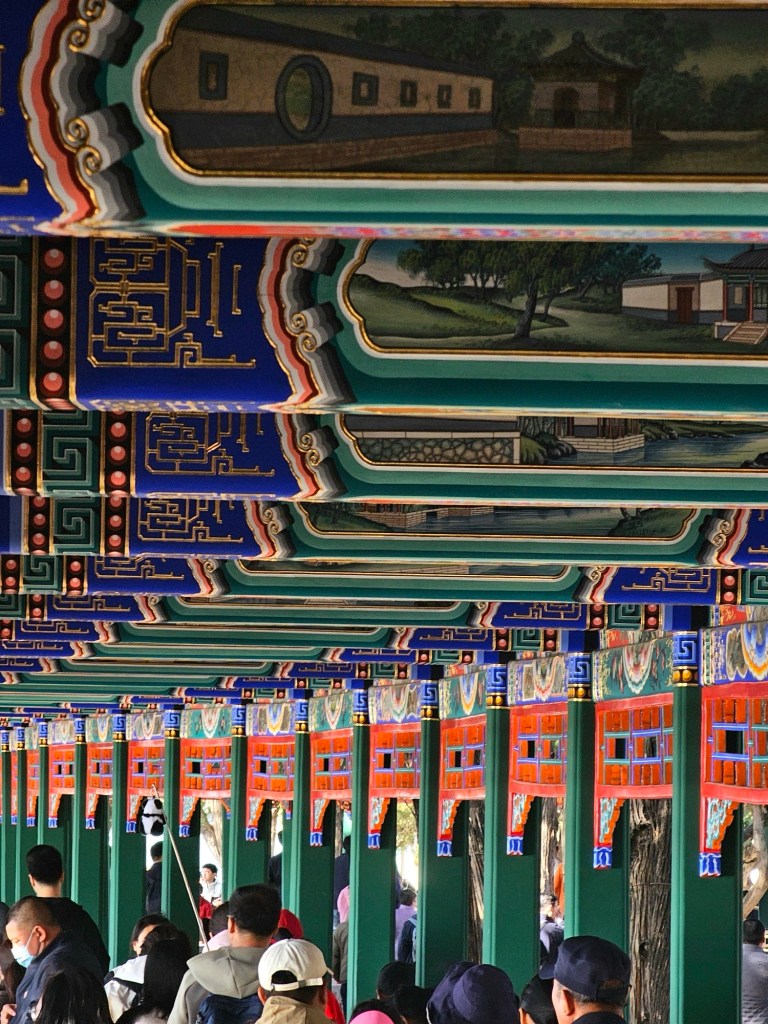
We walked along the Long Corridor, a covered walkway that stretched for 728 metres, decorated with more than 14,000 painted beams. I asked Ashley if the Empress Dowager Cixi, sometimes referred to as “the Dragon Lady”, had used the corridor for exercise, protected from the sun while enjoying the view over the lake. Although I had read that she often walked there, Ashley almost laughed at the suggestion that it was for exercise. According to her, Cixi rarely walked on her own.
Cixi had invested heavily in rebuilding the Summer Palace after it was destroyed in 1860, using funds originally intended for the Chinese navy. To justify this, Kunming Lake was used for naval training.
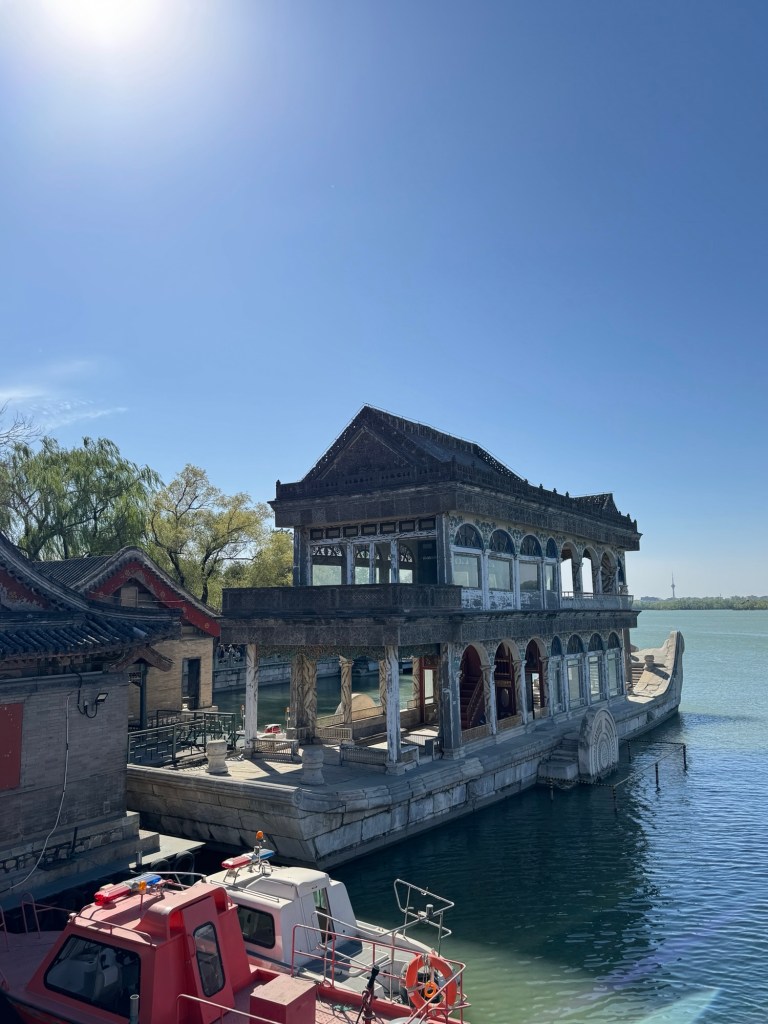
One of the most striking structures was the Marble Boat, a 36-meter-long, two-story pavilion in the shape of a vessel by the lake. It was meant to symbolize the stability of the Qing dynasty. There was a saying that the people were the water and the ruler was the boat; if the ruler was weak, the boat would tip over. The Marble Boat, however, was unsinkable.
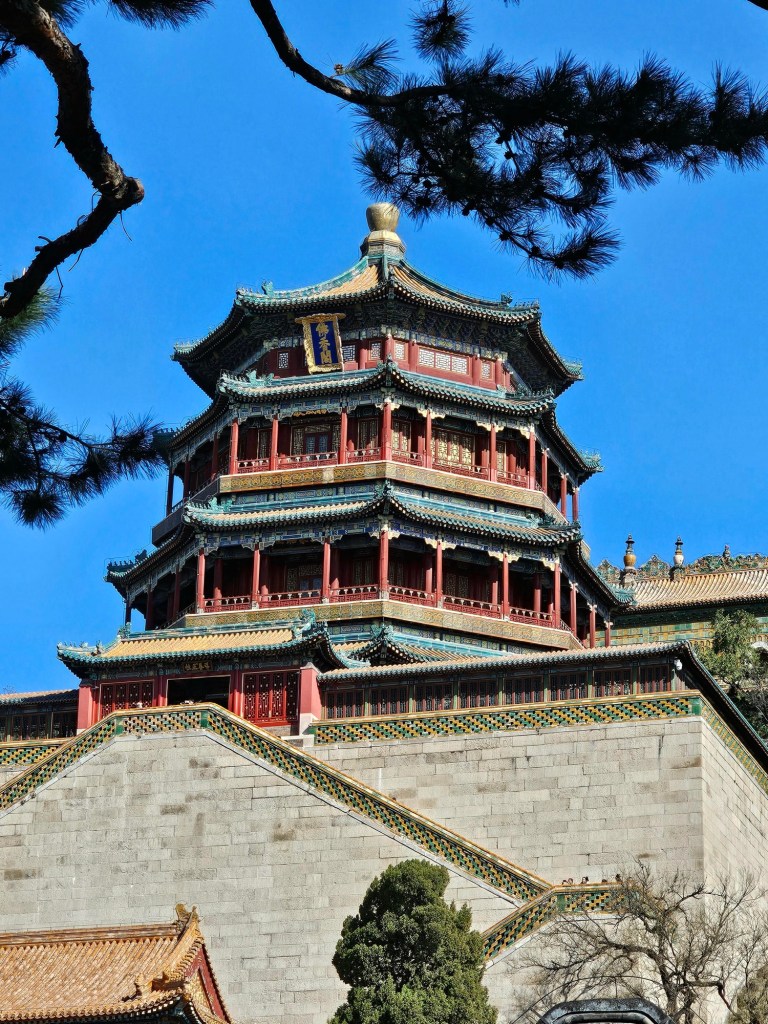
We walked the winding road up Longevity Hill to take in the view from the Tower of Buddhist Incense. The tower itself and the view from the top were quite a sight.
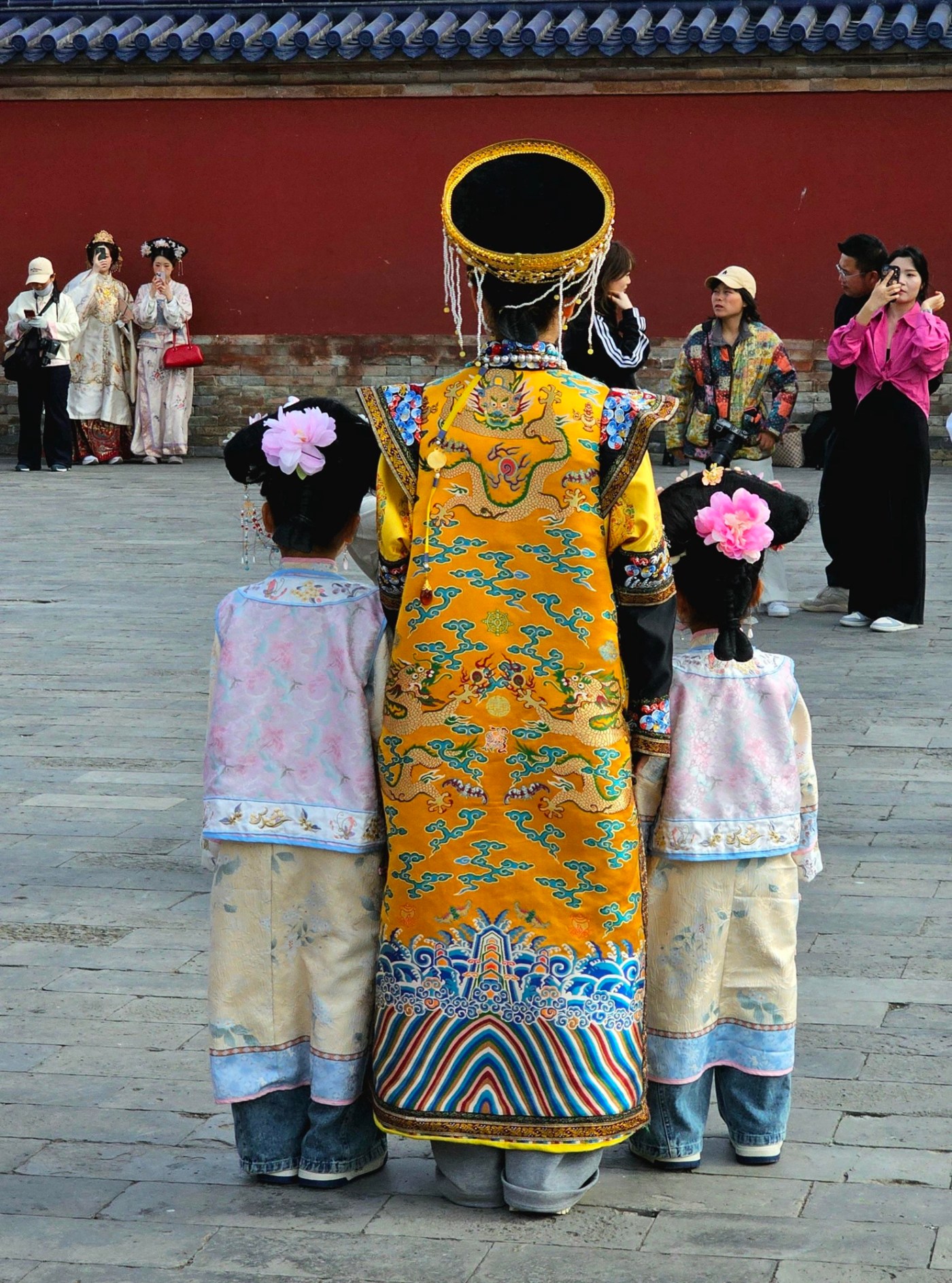
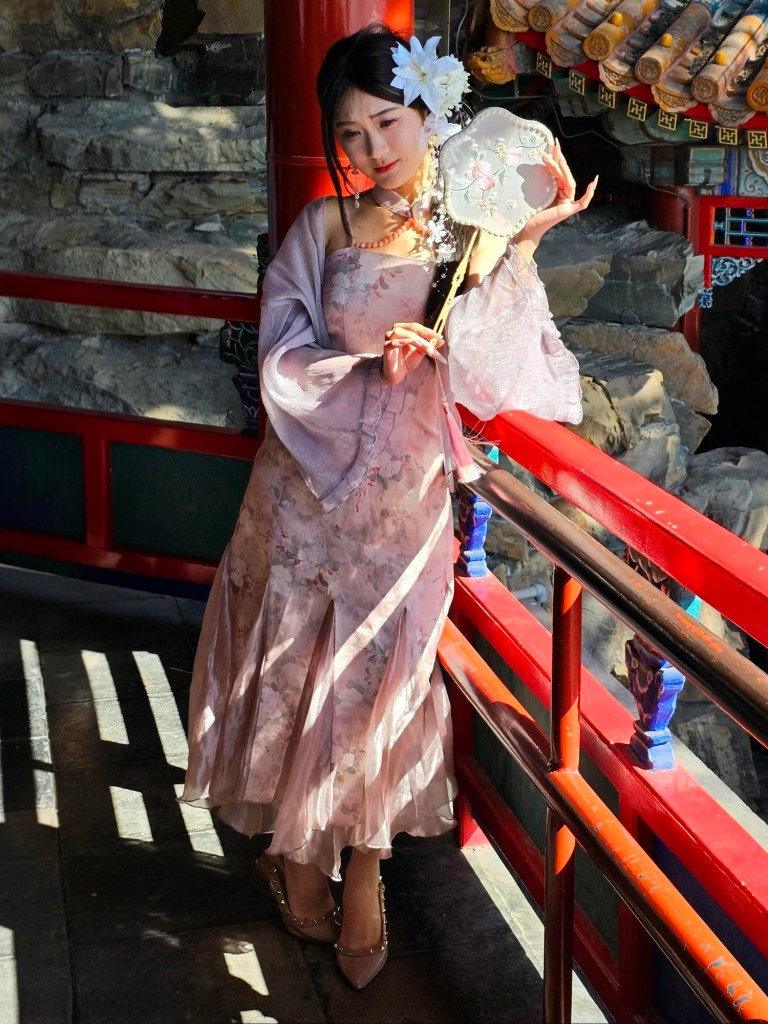
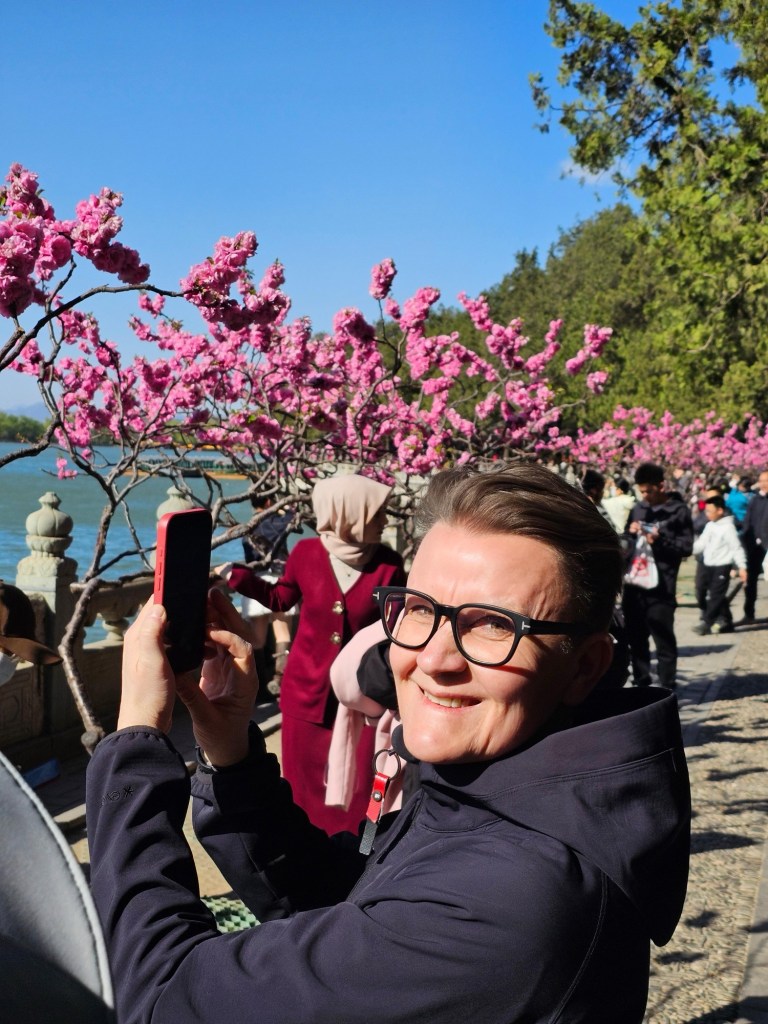
Along the way, we saw young women dressed in traditional costumes posing for photos everywhere, just as we had in the Forbidden City. With the cherry blossoms in bloom, it was a visually impressive scene.
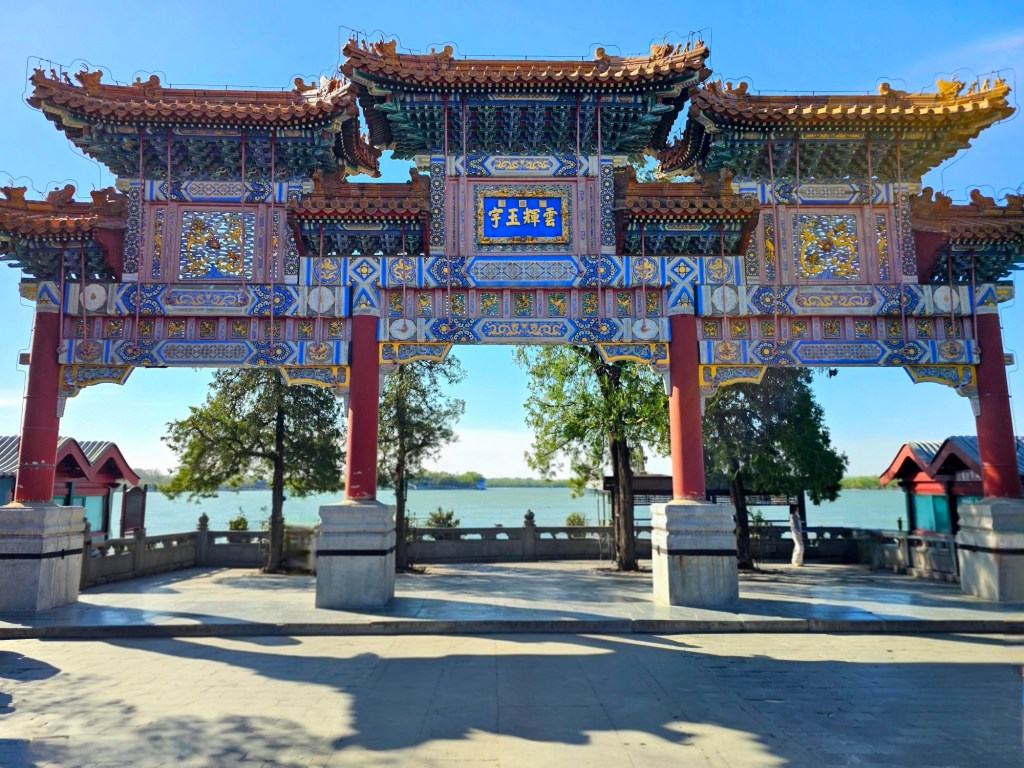
Our next stop was the Old Summer Palace, also known as Yuanmingyuan. The ruins were less visually striking than the vibrant and restored Summer Palace we had just visited, but it was clear this place held a very different significance.
Ashley seemed particularly passionate about this site. She explained that for many Chinese visitors, Yuanmingyuan is not just a historical ruin, but a place of reflection and national memory. Closely connected to its destruction by Anglo-French forces in 1860, it is often used today as a symbol of a difficult period in China’s history.
According to her, it serves as a reminder of the importance of national strength, development, and self-reliance—the idea that a country must be strong to protect its history and sovereignty.
On Monday, April 6, we had another private tour booked. We were originally scheduled to leave around lunchtime, but the driver had contacted us beforehand to ask if we could leave much earlier because of the festival and the expected crowds. We agreed, and he picked us up at the hotel before sunrise at 6:00.
I had read that Mutianyu is slightly less crowded than some of the other sections of the Great Wall, while still being one of the best preserved.
The driver took us there and bought our tickets for the cable car up to Watchtower 14. He advised us to walk to the left along the wall and continue as far as Watchtower 20 before turning back, warning us that the final stretch was very steep. We agreed to meet him later at the café where we had stopped for coffee before beginning our walk.
It turned out to be a very good idea to arrive so early. The morning was a bit chilly, but the wall was almost empty as we began our walk.
The wall was impressive and a lot harder to walk than I had expected. At first, the path sloped gently downhill, but it soon became steeper and steeper. The surface was also surprisingly uneven. I consider myself to be quite fit, but climbing the steps toward Watchtower 20 forced me to stop a couple of times just to catch my breath.
Before visiting the Great Wall, I knew (of course) it was one of the world’s most famous landmarks. What I hadn’t really comprehended was its history and proportion.
Mutianyu was originally built during the Northern Qi Dynasty and was later rebuilt and strengthened during the Ming Dynasty. Today, it is one of the best-preserved sections, known for its dense watchtowers and the surrounding scenery.
What surprised me most was the scale of it all. Photographs don’t do it justice. The wall winds its way over the mountain ridges, climbing steeply up and down as far as you can see. Standing there, it was easy to understand that this was not only an extraordinary engineering project, but also something that must have required an unimaginable amount of labour and resources to build and maintain.
As we made our way back to Watchtower 14, we met more and more people on their way up. That made us even more grateful we had started our walk at 7:45.
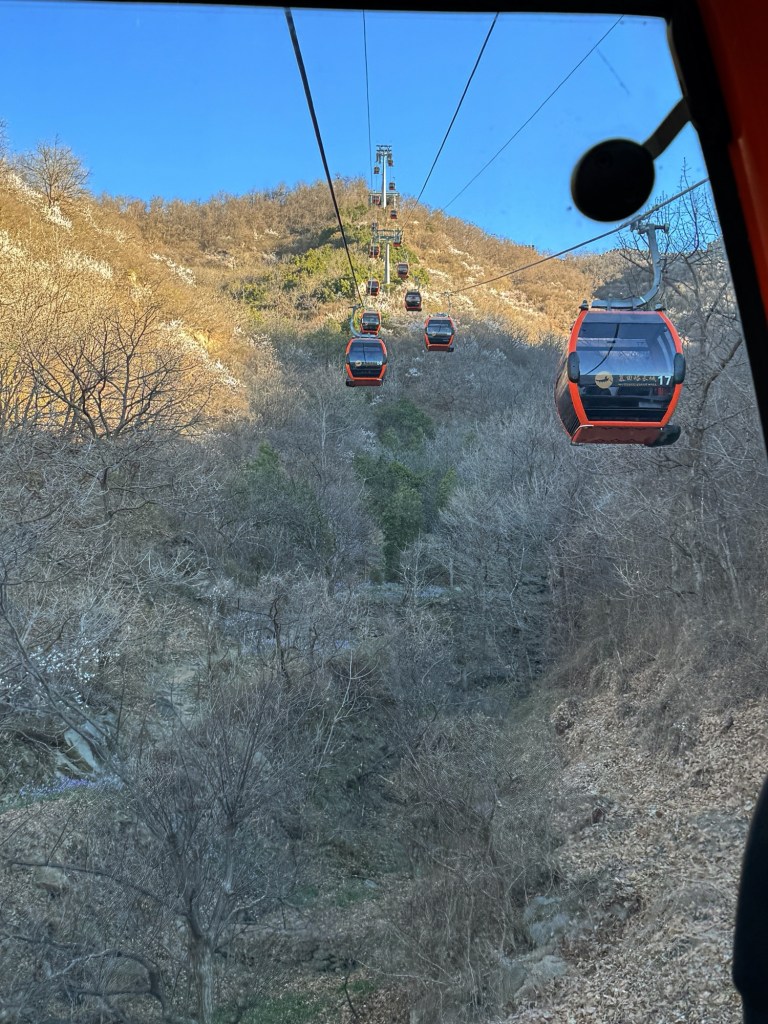
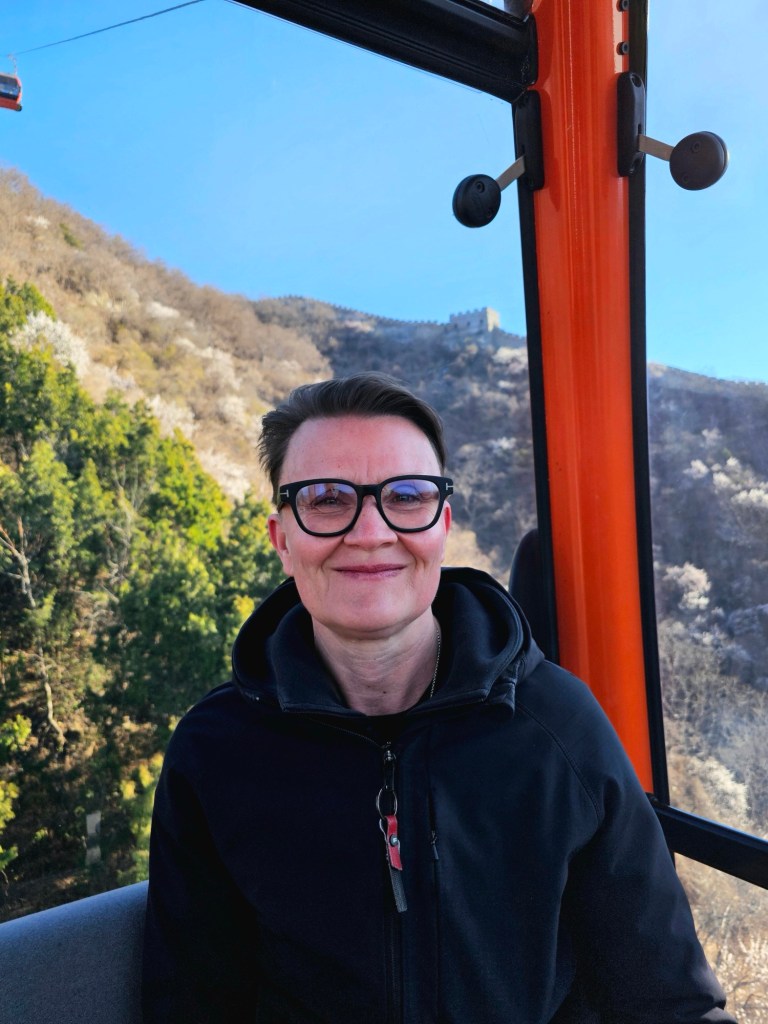
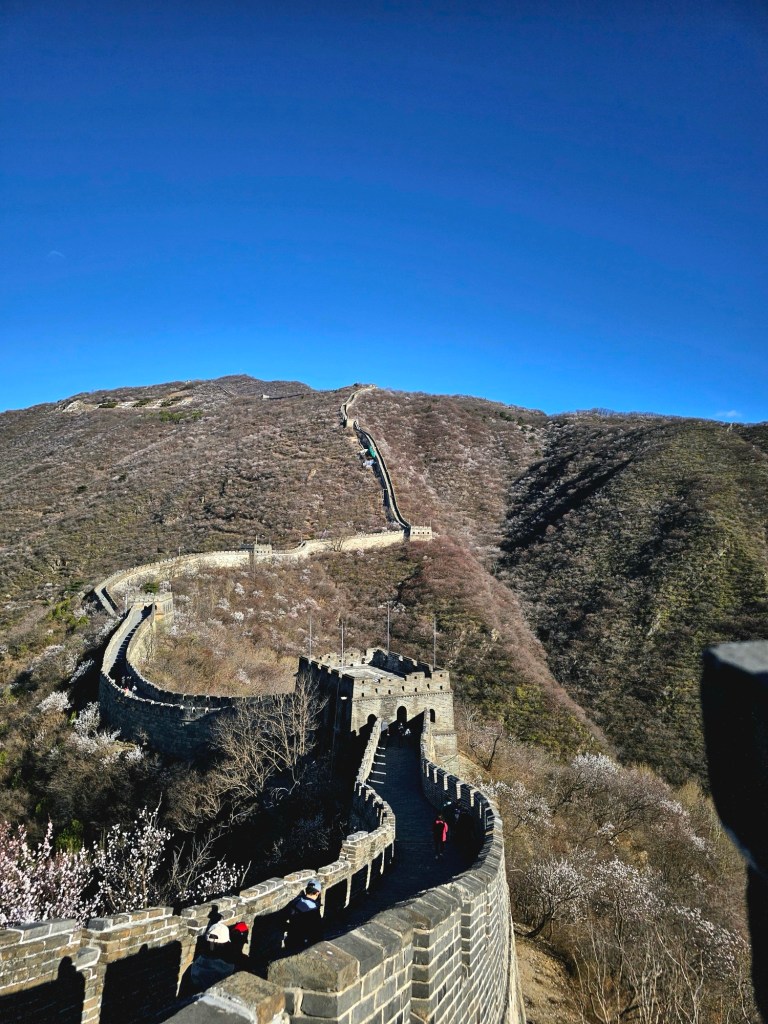
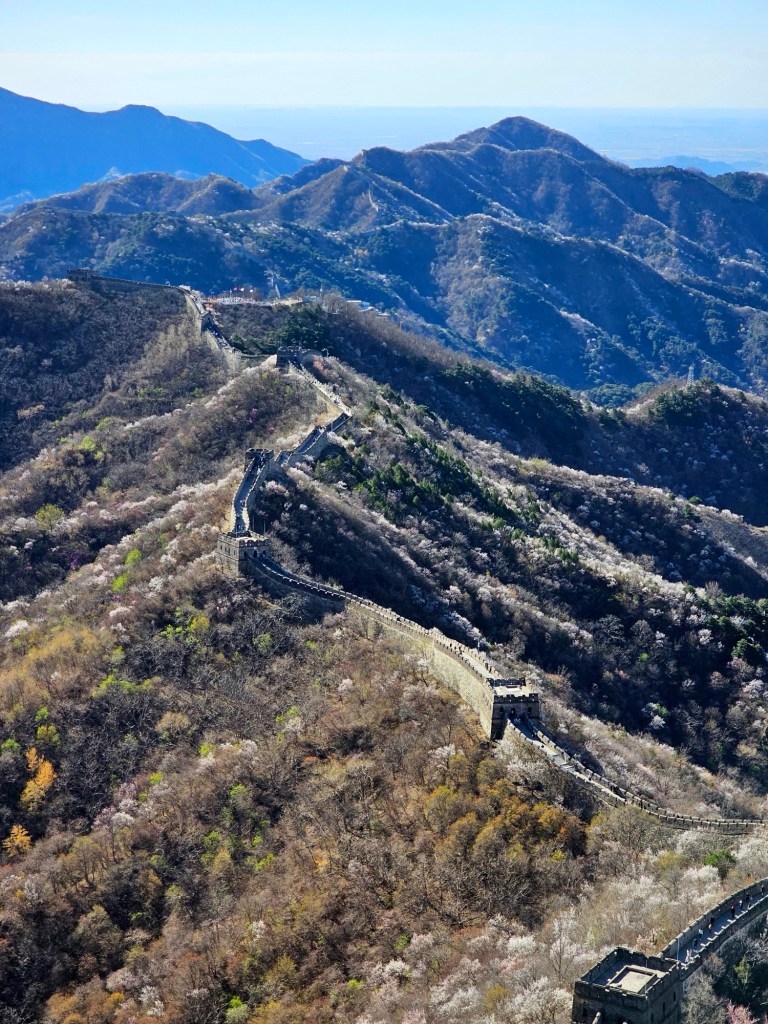
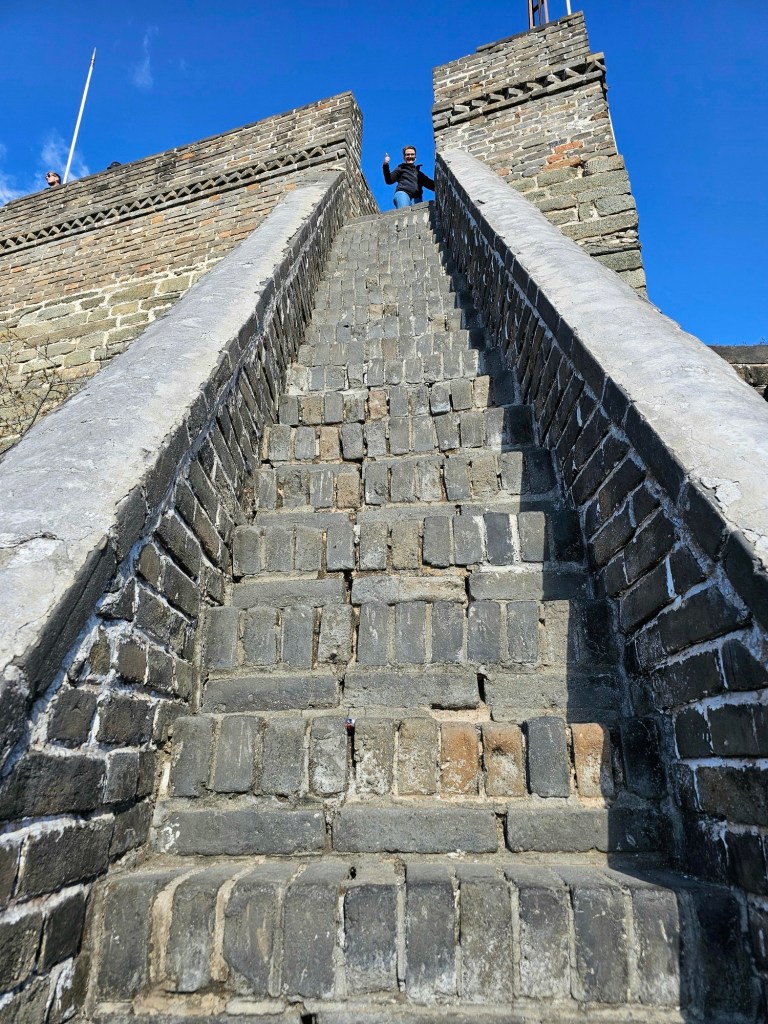
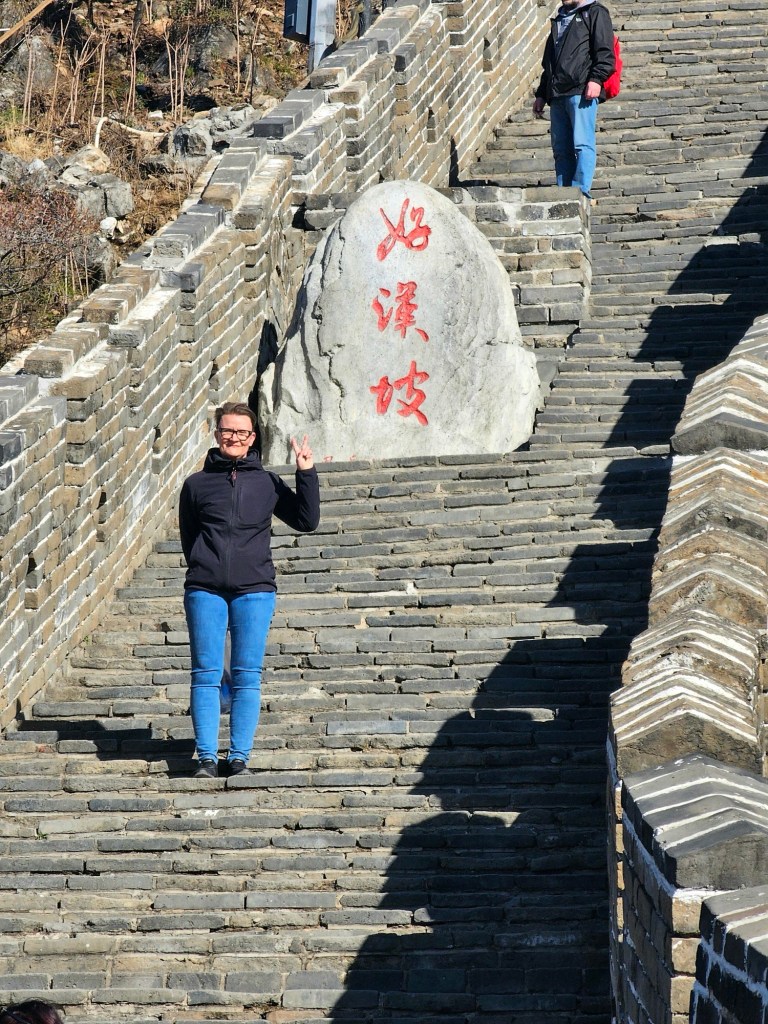
We ran into our driver by chance near the public facilities. Earlier, he had offered us what he described as compensation for leaving so early: on our way back to Beijing, he would take us to a teahouse where we could take part in a traditional tea ceremony free of charge. Since it was free, we thought, why not?
When we arrived at the teahouse, we were shown into a private room where a woman introduced us to different kinds of Chinese tea. She explained their characteristics, what they were traditionally believed to be good for, and invited us to taste several varieties.
We genuinely enjoyed the experience. Afterward, as expected, we were led through the shop. Feeling inspired by the tasting, we decided to buy some tea for ourselves and another package as a gift.
What we did not do, however, was ask for the prices.
When I paid, without really thinking about it, we realised we had spent considerably more than intended. It was an expensive lesson. During the drive back to Beijing, we contemplated our own foolishness. We felt slightly conned, but in all honesty, we only had ourselves to blame; neither of us had thought to ask how much the tea cost before buying it.
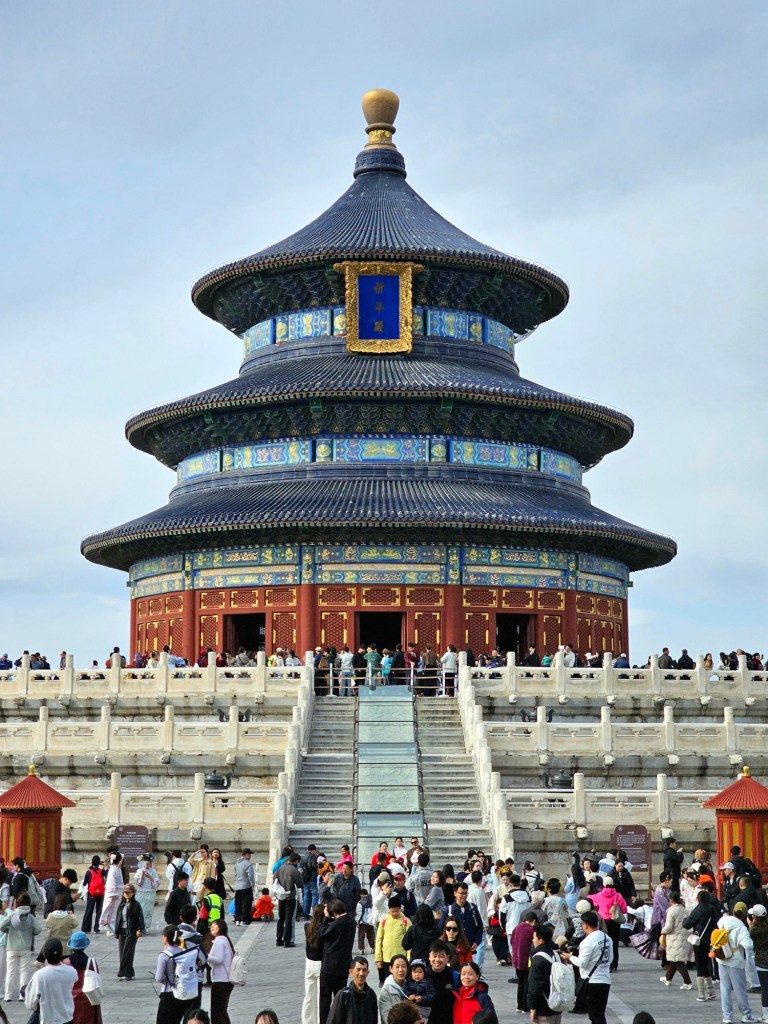
In the afternoon, we were set on checking off a few more sights from our list, so we took the subway to Tiantan Road, where the Temple of Heaven is situated.
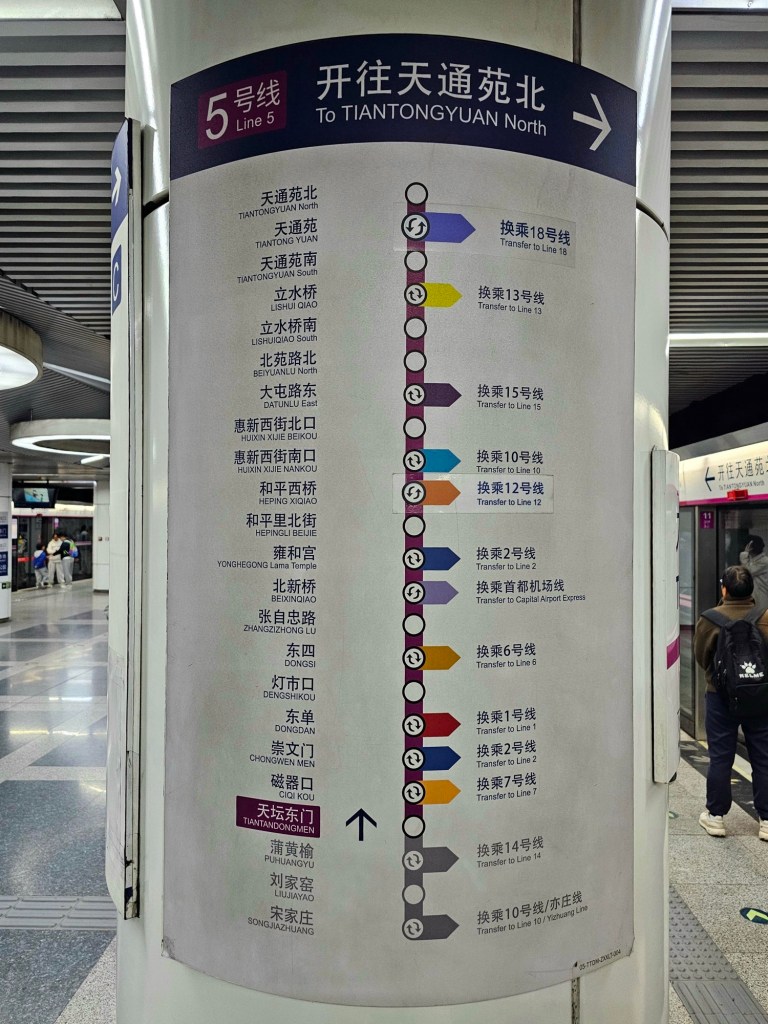
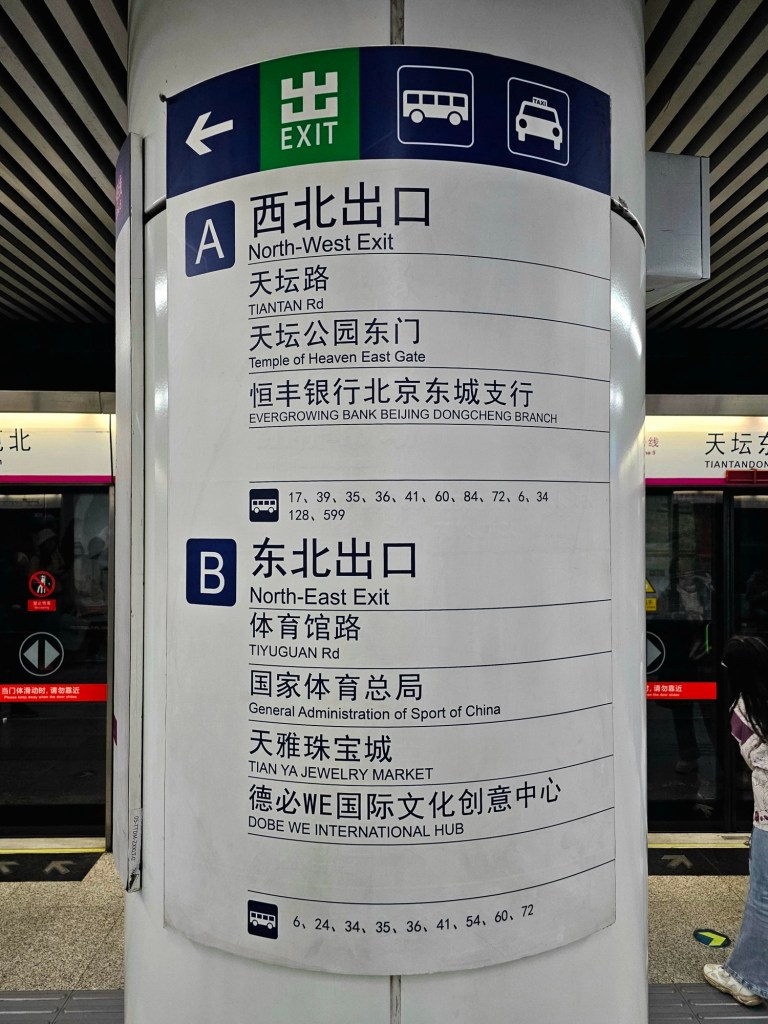
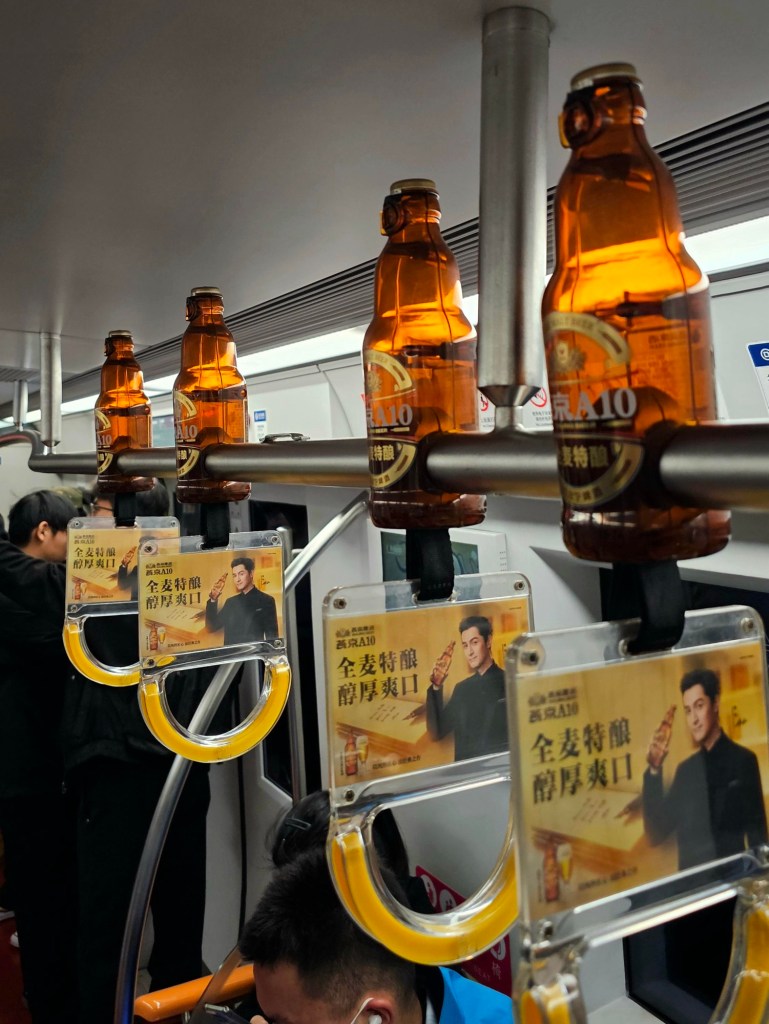
Travelling by subway in Beijing turned out to be fast, affordable, and very tourist-friendly. At first, we thought we had to buy tickets, either through the Alipay app or from the vending machines at the stations. Then we realised we could simply tap in and out with our credit card. The station names were written in both Chinese characters and Western letters, making navigation surprisingly easy.
One thing that struck us during our time in Beijing was just how digital Chinese society is. They have their own apps and platforms for almost everything, many of them local equivalents of well-known Western services. WeChat, for example, combines messaging, payments, and several other functions into one app, and there are Chinese equivalents of Instagram, TikTok, and Amazon as well. In many ways, it felt as though they were a few steps ahead of us when it came to integrating digital services into everyday life.

Just like us, the Chinese seemed to spend their subway rides with their noses buried in their phones.
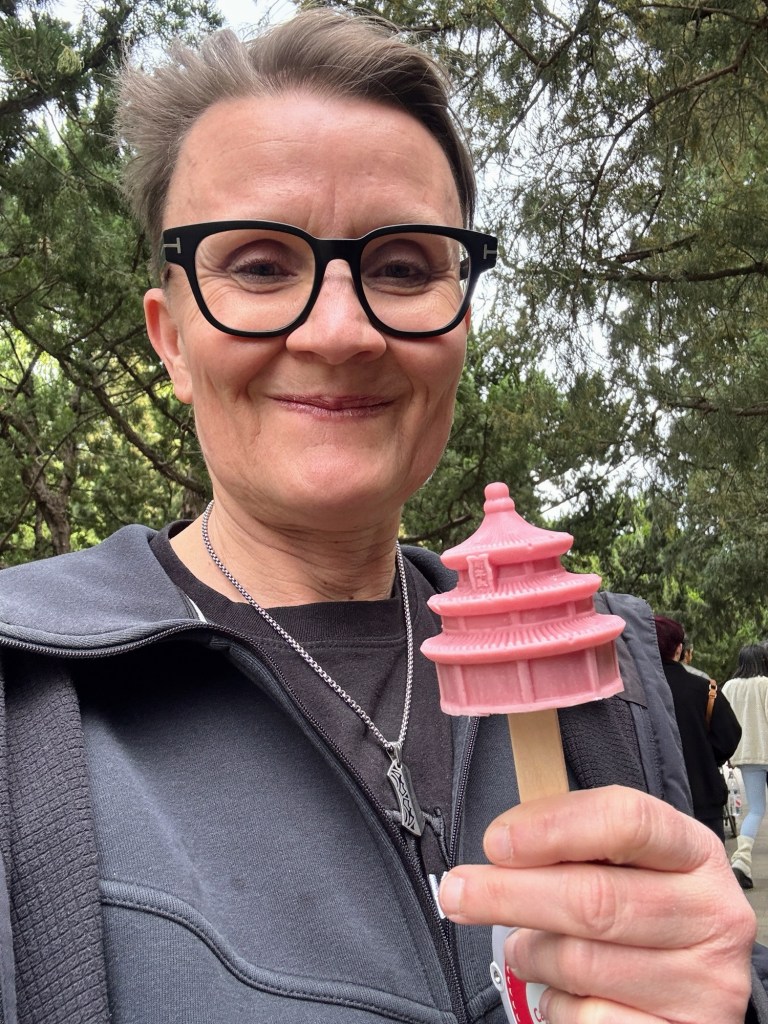
When we arrived at the Temple of Heaven, we felt like having a coffee and an ice cream. I bought an ice cream in the shape of the temple itself. It didn’t taste like much, but it looked exactly as it should and was priced accordingly.
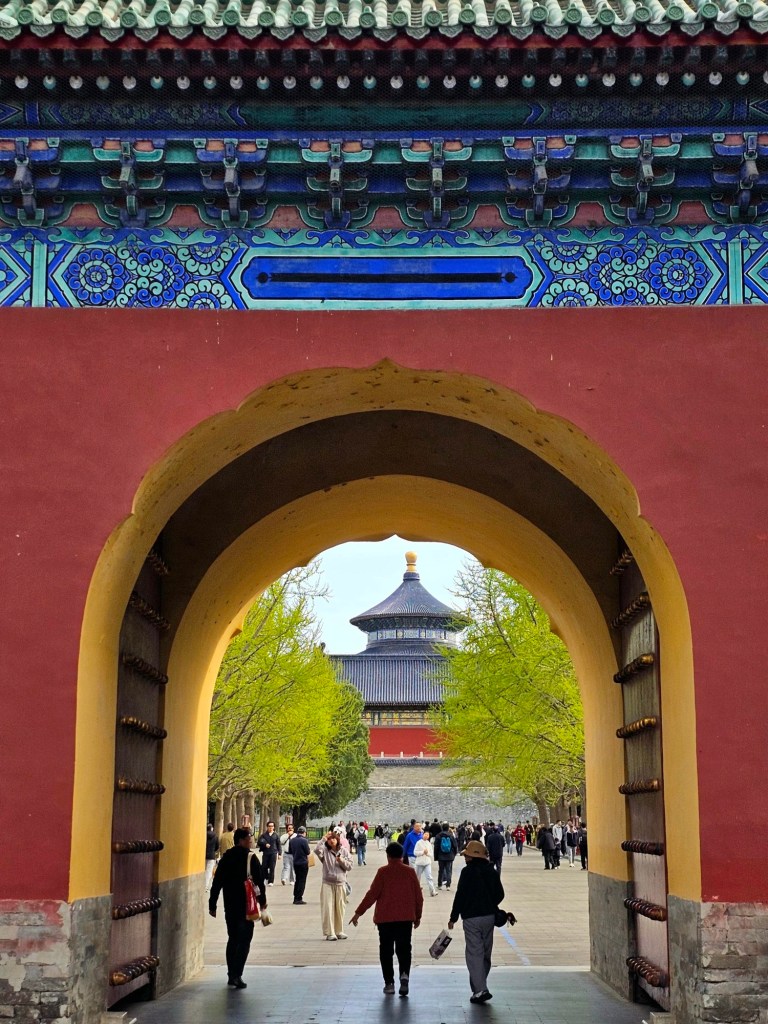
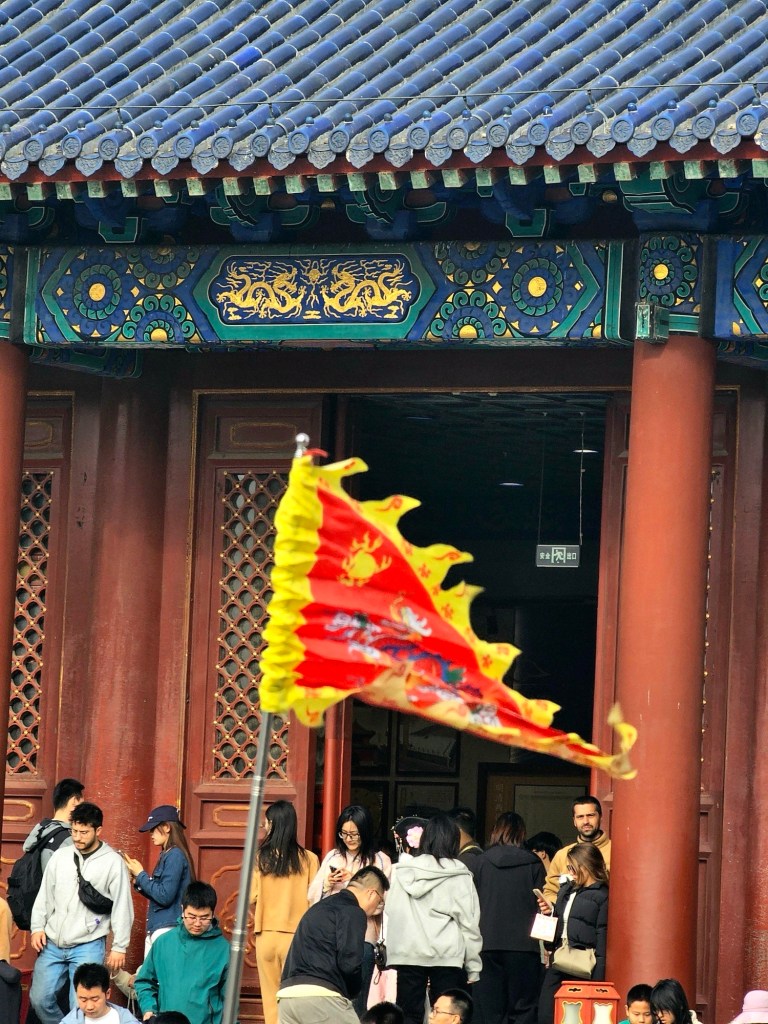
The temple was impressive, but without a guide this time, we couldn’t learn much about its history while we were there. Instead, we walked around the structure several times, taking colorful photos and watching the crowds. Just as at the Summer Palace, many visitors were dressed in traditional clothing, posing for family photos.
Oliver actually takes most of the photographs we end up keeping; he has a much better eye for composition than I do.

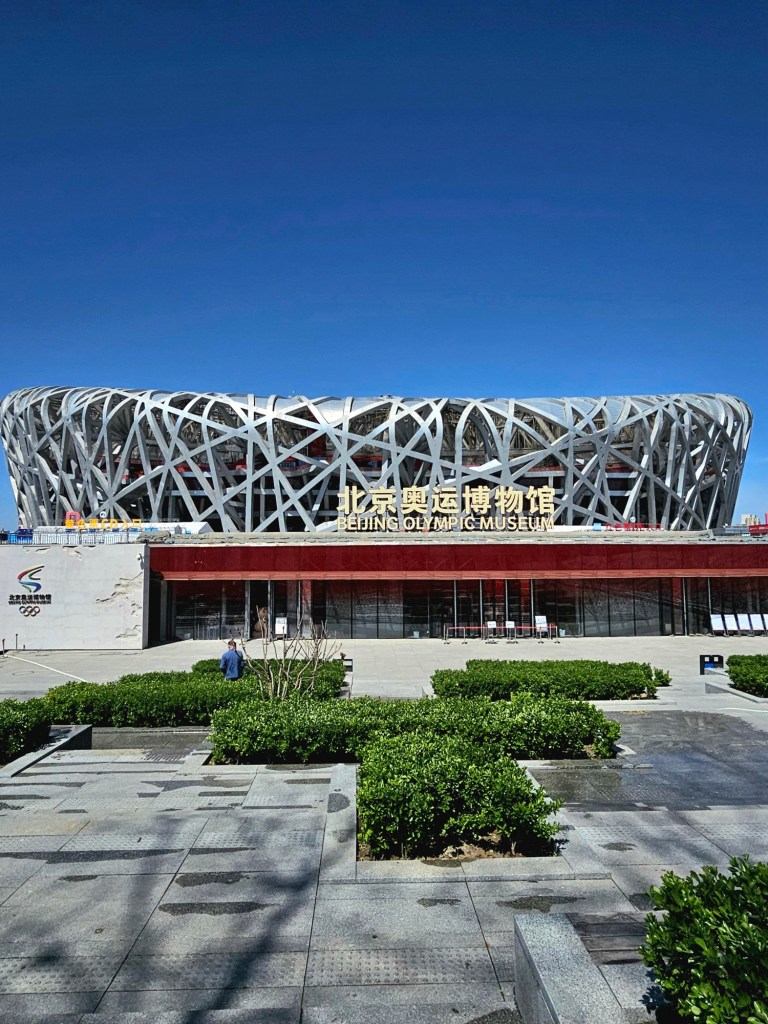
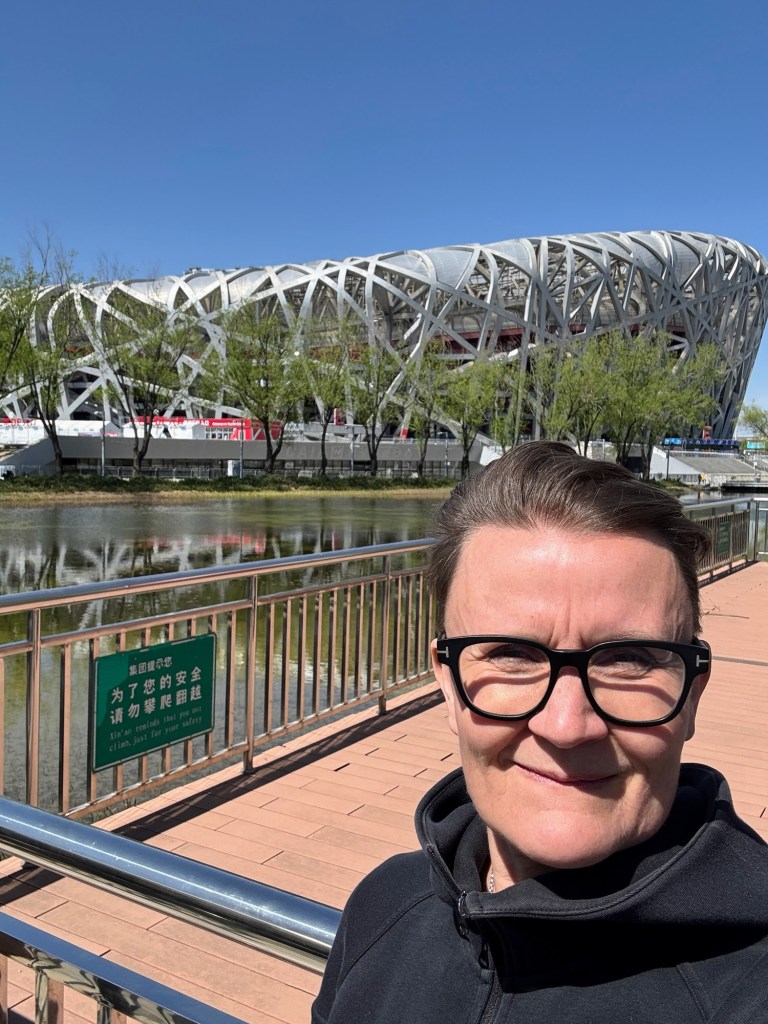
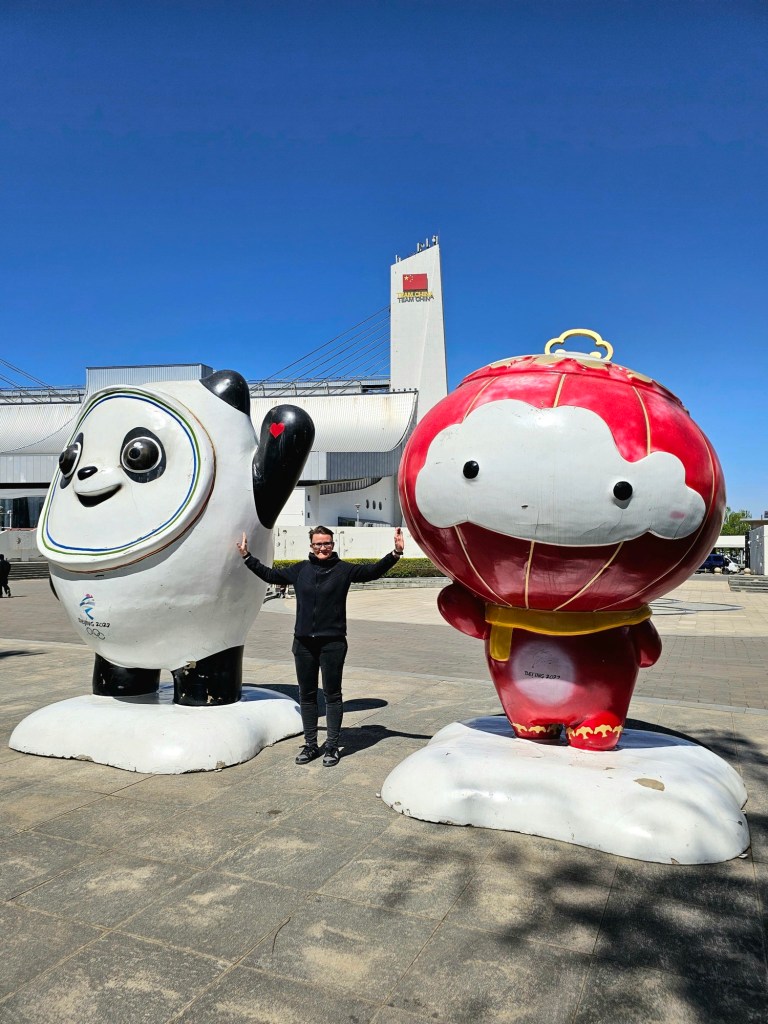
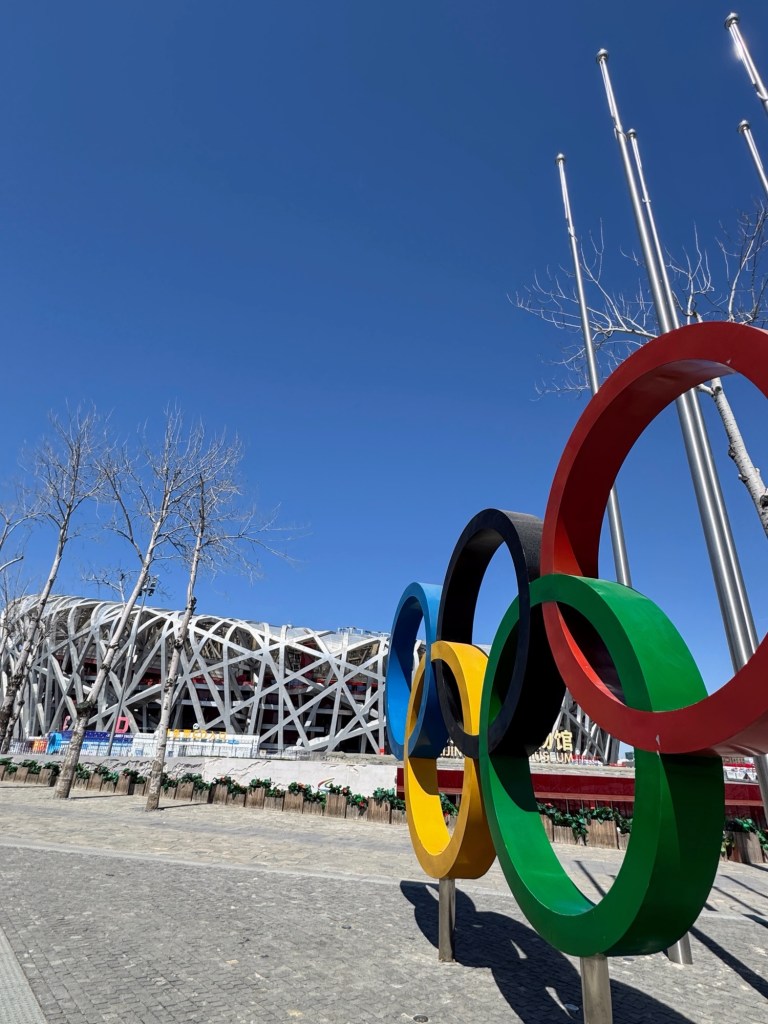
The next day, we visited the Olympic Park area, where Beijing hosted both the 2008 Summer Olympics and the 2022 Winter Olympics.
We walked around the complex, taking photos of the National Stadium, famously nicknamed the “Bird’s Nest.” It was a hot, sunny day. We had planned to go up the Olympic Tower for a view over the city, but it was closed for repairs. Instead, we decided to look for an alternative viewpoint and called a DiDi to take us to the Central Radio and TV Tower.

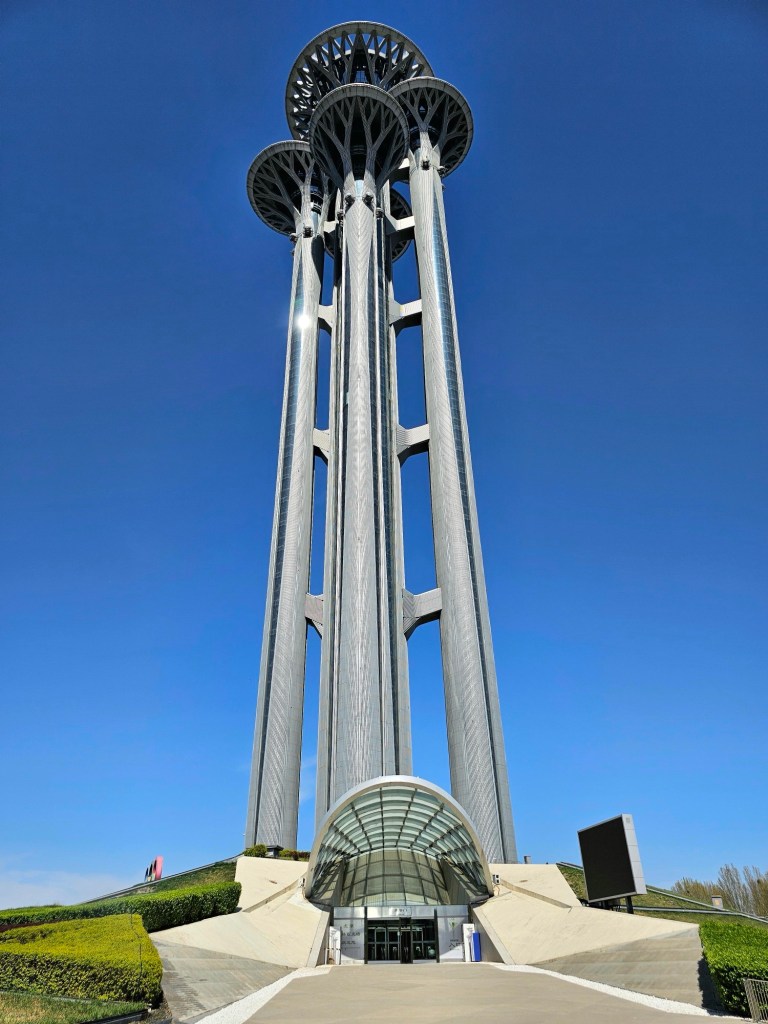
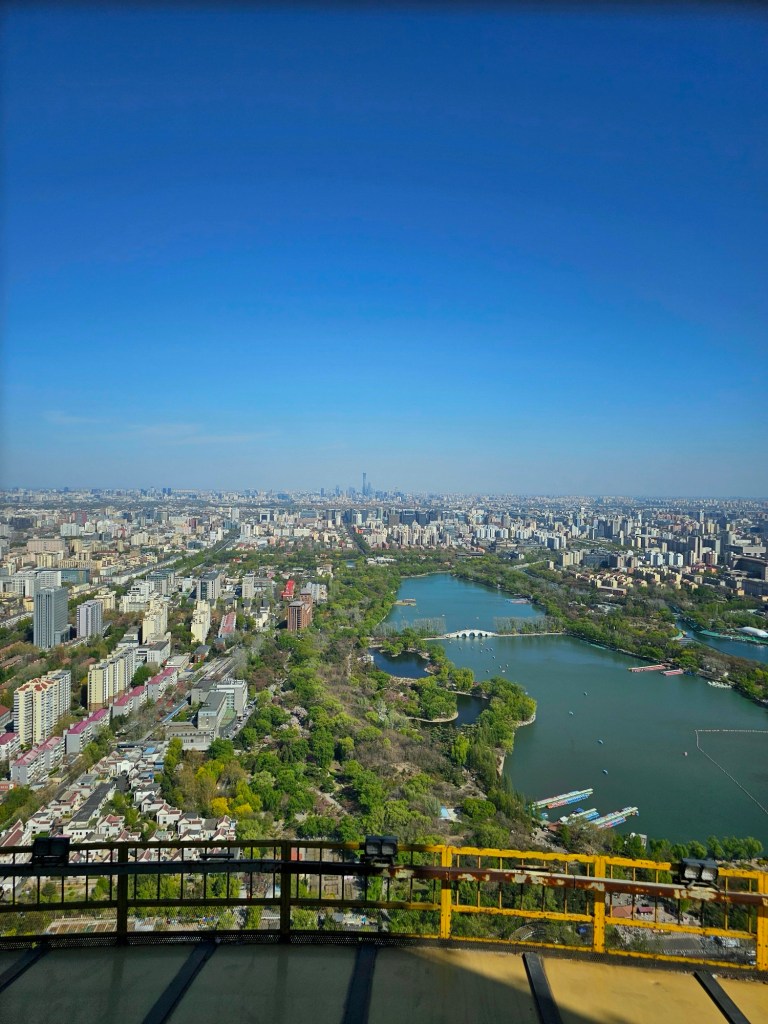
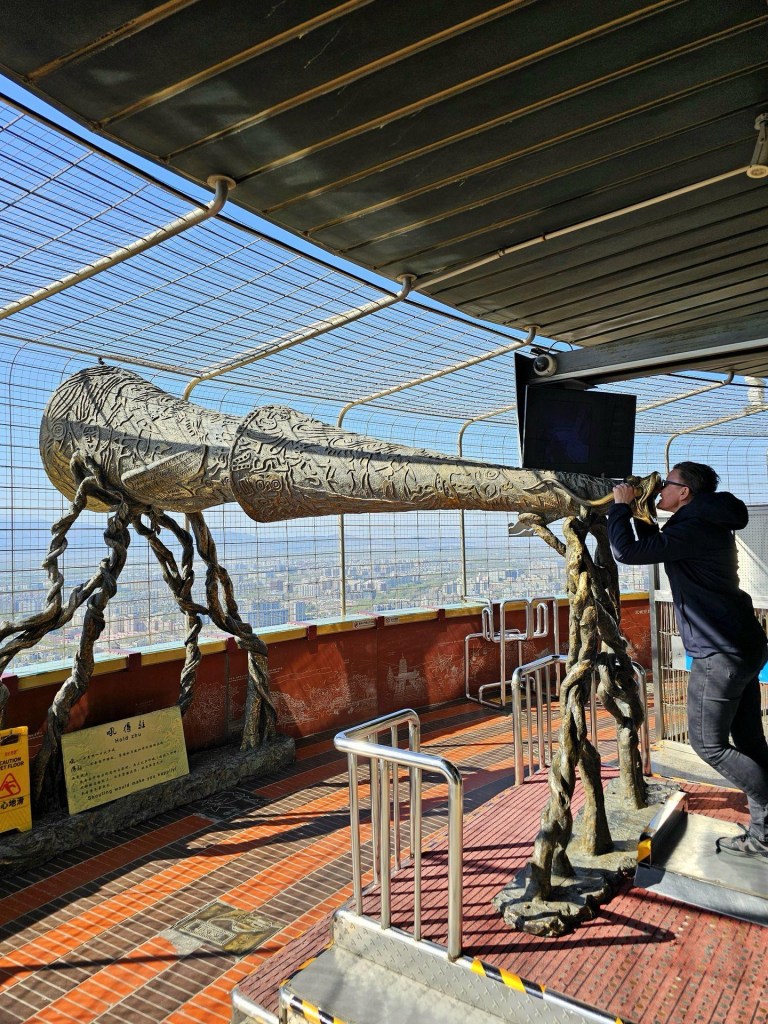
The TV tower is the ninth tallest in the world, and the circular viewing deck gave us a great view of Beijing. While walking around, we came across something unexpected: a gigantic horn. It turned out to be an interactive decibel-measuring installation on the open-air deck where visitors could shout into it and see their volume level displayed on a screen.
Naturally, I had to give it a try. I bellowed into the horn, announcing to Beijing and possibly the rest of the world, that Oliver and I wanted 8 million euros. I have no idea how many decibels I reached, but I noticed that the guard standing next to the installation chuckled to himself while repeating, “8 million euros.” It probably wasn’t a wishing horn, but there was no harm in trying.
On the way back to the hotel, we started discussing what to eat. We had a rather disappointing food experience a few days earlier at a restaurant nearby. As usual when ordering food in China, we relied mostly on pictures and pointing, since we couldn’t read the Chinese characters and the staff’s English was limited.
We thought we had ordered chicken stew, but what arrived was a dish that tasted quite good, even though it turned out to consist mostly of chicken pieces with a surprising number of small bones. It was a learning experience.
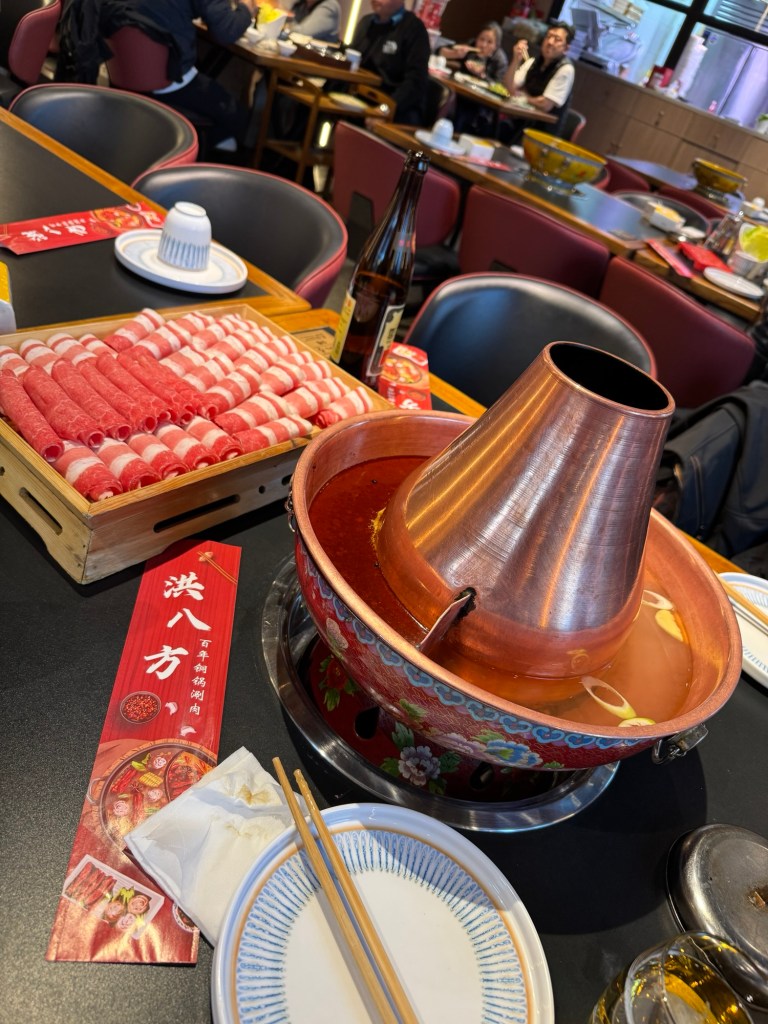
This time, we happened to stumble upon a restaurant specializing in hot pot, without knowing anything about it beforehand.
Hot pot is a communal meal centered around a pot of simmering broth in the middle of the table. It reminded us of fondue, but instead of dipping bread or meat into hot oil or cheese, you cook thin slices of meat and vegetables in a flavorful broth.
We were presented with a menu of different ingredients, but it quickly became clear that we were out of our depth. When we tried to explain this to the elderly couple who owned the restaurant, mostly using gestures, they kindly stepped in to help. They recommended a pot split with two different broths, one slightly spicy, along with two plates of paper-thin slices of high-quality meat and a plate of vegetables. We could then choose additional ingredients for the dip sauce from a buffet table.
The process was simple: take a piece of meat, place it in the simmering broth until cooked, dip it into a sauce, and eat. It was not only delicious, but also a fun and different way of having a meal.
It was definitely my favourite meal of the entire trip.
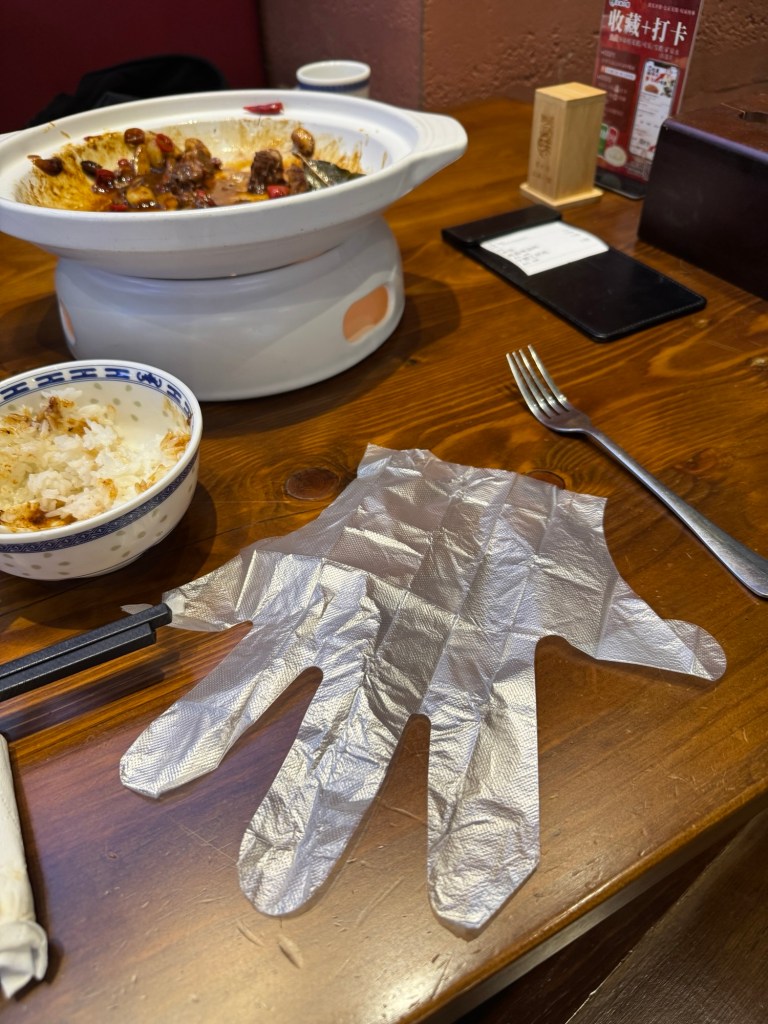
The moment you are given a plastic glove to eat your dinner, you should probably be suspicious.
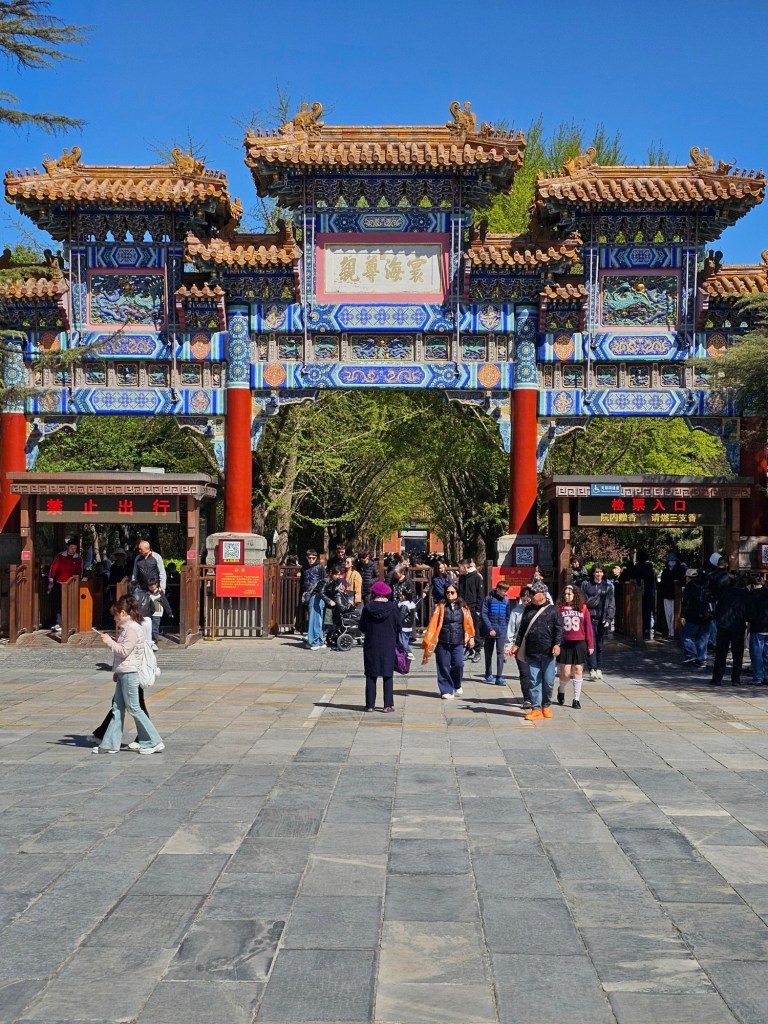
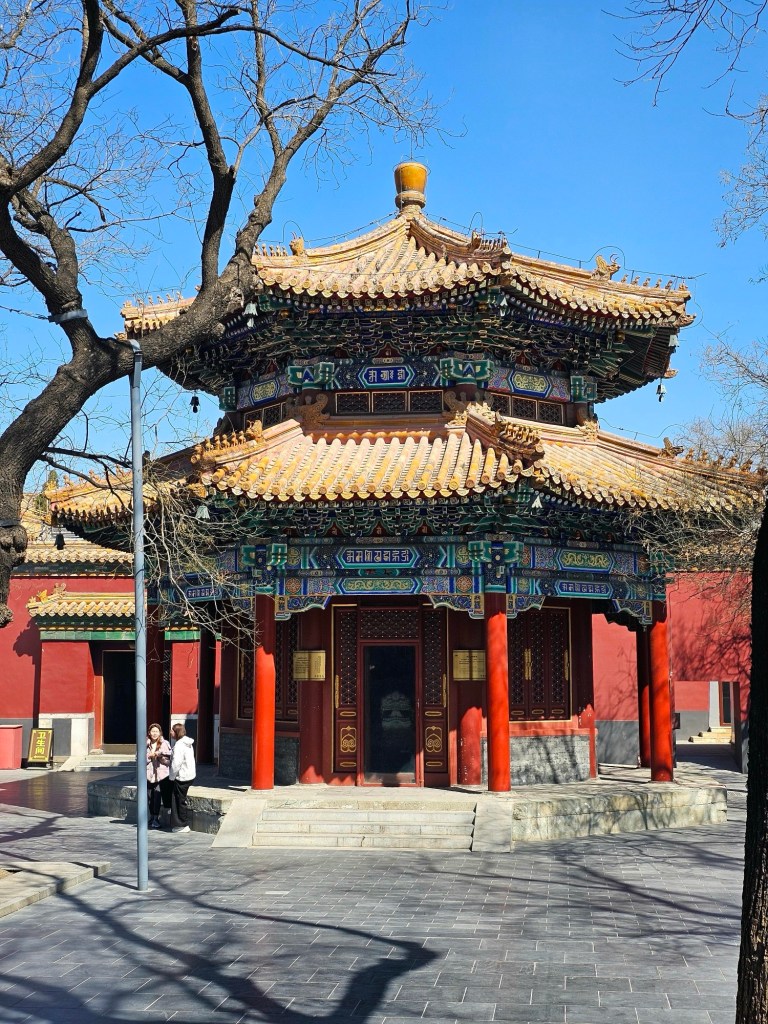
One of the last places we visited in Beijing was the Lama Temple. Unlike many of the historical sites we had seen, this was an active monastery, still used for worship, where visitors could take part in religious rituals.
We entered a complex of beautiful buildings dominated by yellow tiles and red walls. What made the experience special was seeing that many of the people around us were not tourists; they had come because this was their actual place of worship.
In the courtyards, worshippers bought incense sticks to use while praying. The air was thick with smoke as people bowed, made wishes, and placed their incense into the ash burners. Worshippers knelt on cushions to pray, following traditional practices that created an atmosphere completely distinct from the other sights we had visited. While monks were present, their main role seemed to be ensuring the visitors behaved. Still, we could hear prayers all around us, smell the incense and feel that the temple was ancient but also very much alive.
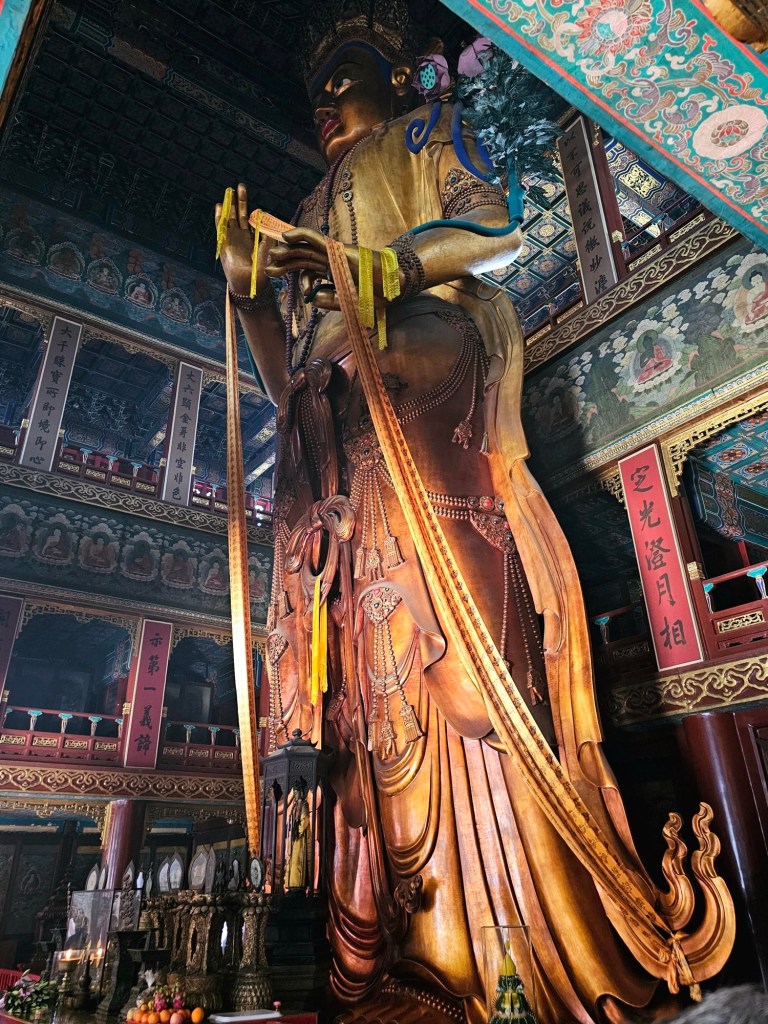
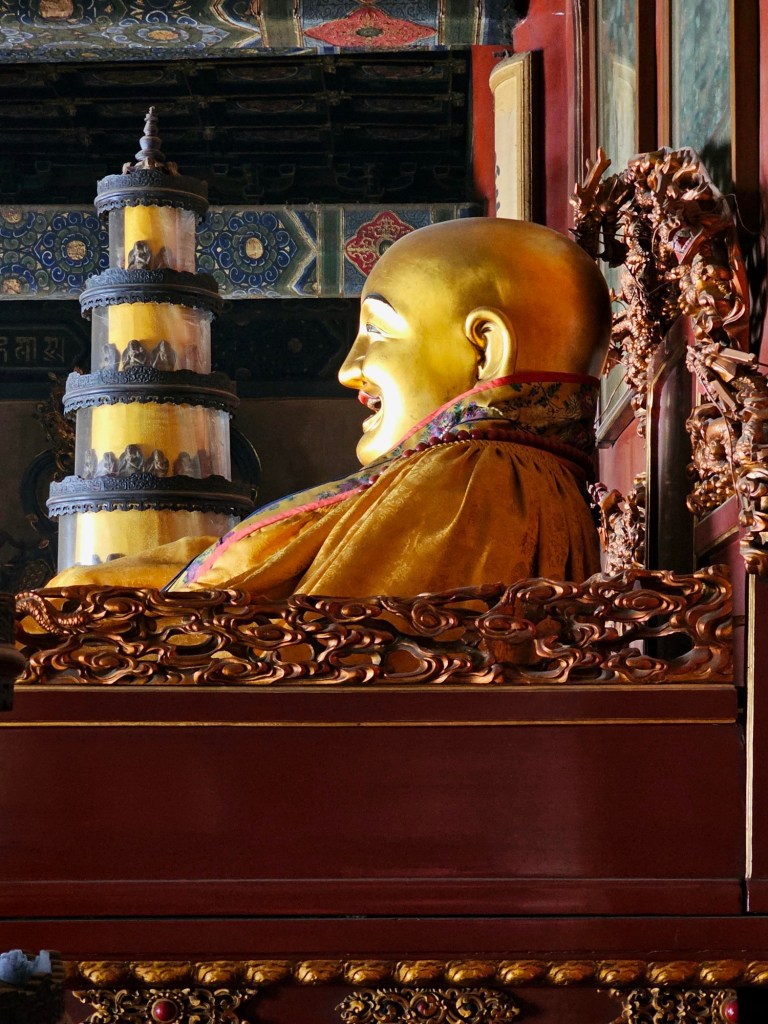
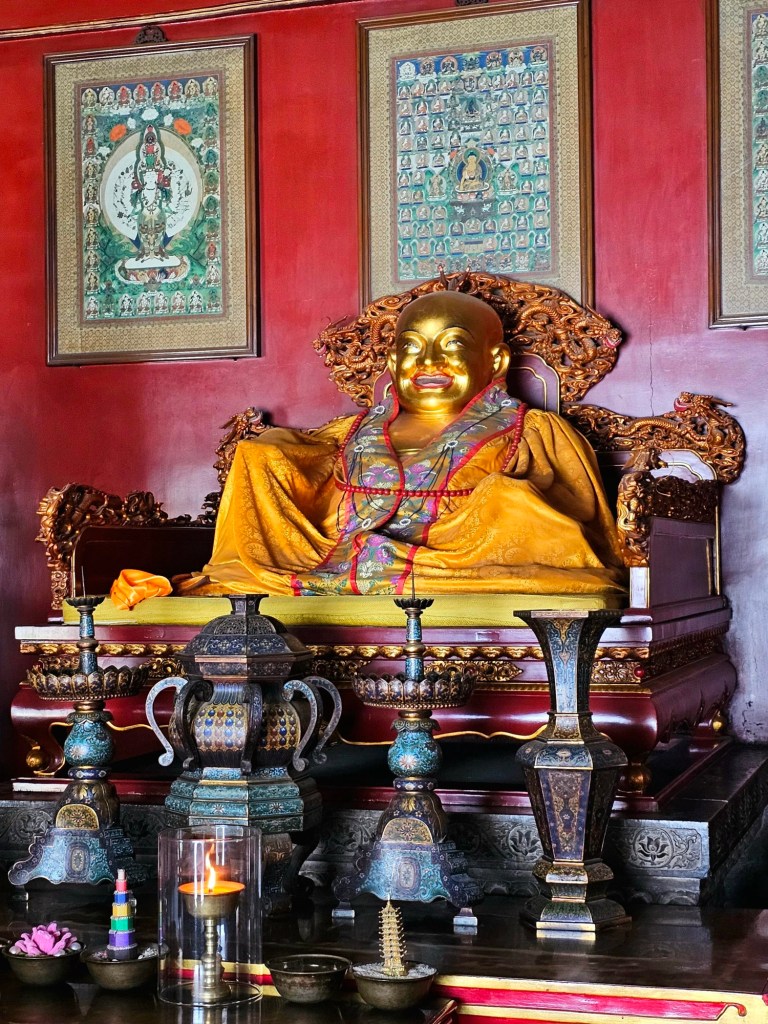
Inside, the halls were filled with impressive statues of gods and Buddhas. My favorite, though, was the laughing Buddha. In one of the halls, we also saw an enormous Buddha statue so tall we could barely see its head from the floor. The statue was 26 meters high, with 18 meters above ground, and had been carved entirely from a single piece of rare white sandalwood.


After almost a week in Beijing, it is time to reflect on our experiences. If you have managed to read this far and get through the whole post, congratulations (this is unusually long for me!). Looking back, there were many things that surprised us, some we had expected and others we hadn’t thought about at all.
For some years now, we have spent the Easter holiday overseas. This year, we chose China because we didn’t want to support the US under its current administration. Travel to the US felt very uncertain, especially after hearing about European visitors, including people from Germany, being detained there for different reasons.
I had never prepared so much for a trip. Before leaving, we read extensively about China, especially regarding the restrictions on Western apps and how closely both citizens and visitors are monitored.
We prepared by downloading and setting up Alipay for payments, choosing not to use WeChat. Alipay was also connected to DiDi, the Chinese version of Uber. I downloaded Amap as a backup in case Google Maps wouldn’t work, which turned out to be a good decision. Although we could use Google Maps with a VPN, it couldn’t display the subway lines, making Amap much more useful.
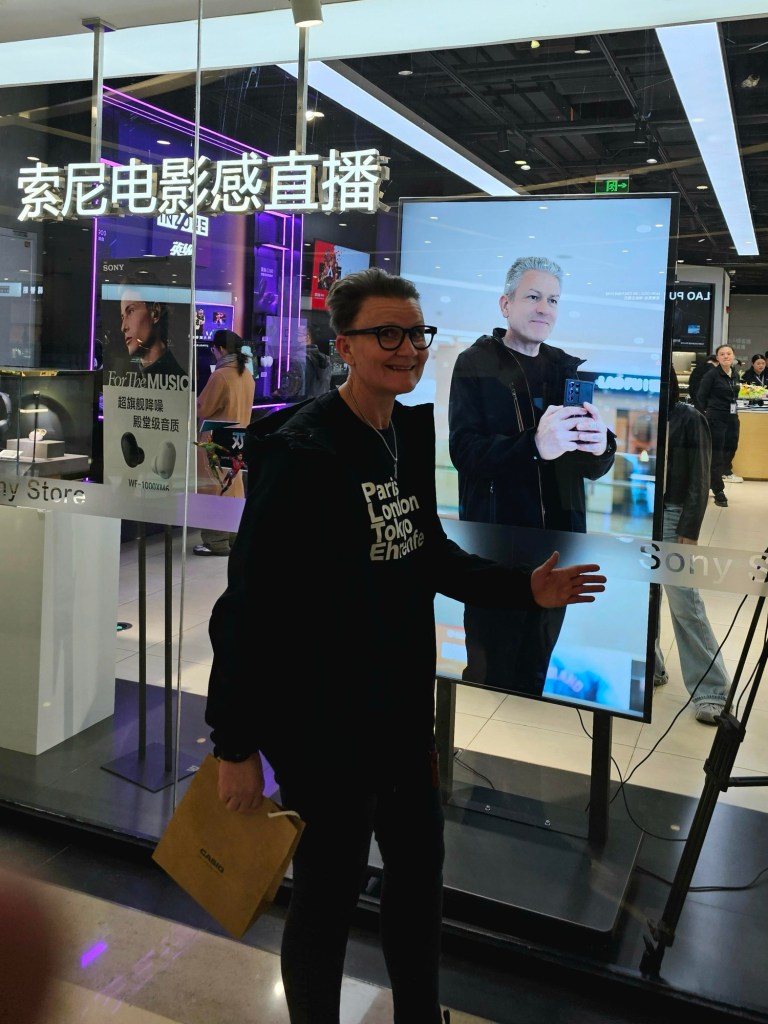
I had also downloaded a translation app, but in reality, I hardly used it. Instead, I mostly relied on DeepL. Taking a photo of a sign and getting an instant translation was surprisingly helpful. In some shops, the staff used their own translation apps, speaking into their phones and showing us the English text on the screen. That was how Oliver communicated when he bought a Casio watch.
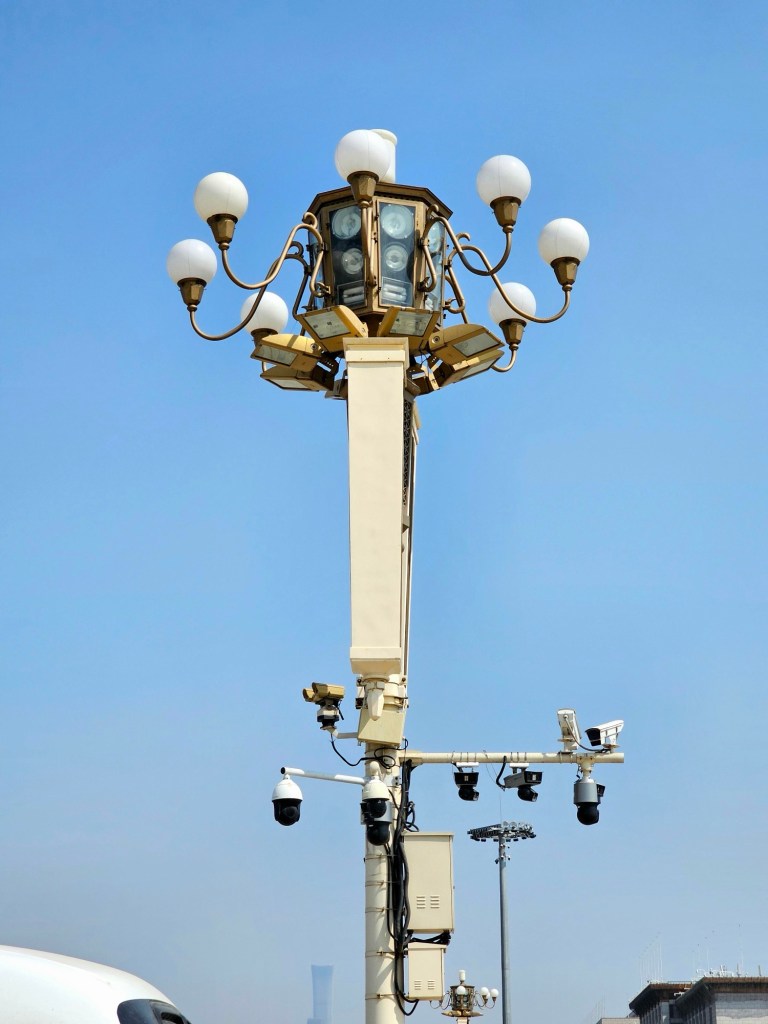
One of the things that stayed with me was the constant feeling of being monitored. When buying tickets for attractions, we had to show our passports. There were cameras everywhere, and entering the subway involved security checks and metal detectors. Even our water bottles had to be checked at the stations.
At the same time, it was impossible not to notice how technologically advanced China seemed. For example, almost all the cars we saw were electric. Even when traffic was heavy, the streets were surprisingly quiet because there was so little engine noise.
Another thing we noticed was that we didn’t see any homeless, unemployed, or drug-addicted people in Beijing. It makes you wonder why, since surely there must be people struggling with addictions even here. When it comes to the lack of visible unemployment, though, the explanation seems simple: everyone is given a job. You see people everywhere in uniforms with brooms, tasked with keeping a specific street clean, or stationed at zebra crossings to make sure pedestrians cross when they are supposed to. In return, they are given somewhere to live.
What I also reflected on was the social layout of the city. There were very few, if any, bars, beer gardens, or coffee shops where you could just sit outside, relax and watch the world go by for a moment.
I had also expected that Oliver’s height would attract more attention than it did. The Chinese are generally shorter than Europeans, but perhaps not quite as much as we had imagined. There were a few encounters, especially with children, where his height clearly caught people’s eye, but overall everyone seemed remarkably unfazed.
And then there was the Great Wall.
It was, without a doubt, the highlight of the trip. Standing on the wall and watching it disappear over the mountain ridges was incredible and it is something photographs cannot really capture.
Seeing how advanced Beijing is has left us really interested in visiting Shanghai next, to experience the ultra-modern side of China. For anyone planning a trip, I highly recommend booking your tours in advance. We booked all of ours beforehand through GetYourGuide and it worked beautifully.



Leave a comment